

Today, August 29, 2025, marks the 25th anniversary of Valkyrie Profile, an RPG that, despite its initial obscurity, has cemented its place as a truly special and enduring classic. We delve into why this game was overlooked upon release and what continues to make it exceptional a quarter-century later.
An Overlooked Gem at Launch
It`s understandable why Valkyrie Profile struggled to gain significant attention during its initial North American release. Japanese publisher Enix had only recently reactivated its US division, likely encouraged by the surge in JRPG popularity following the success of titles like Final Fantasy VII and Sony`s licensing triumph with Star Ocean: The Second Story. However, launching a new PlayStation 1 RPG was an uphill battle. The Dreamcast was already on the market, the PlayStation 2`s US debut was mere months away, and SquareSoft had just released Chrono Cross, a highly anticipated successor to the beloved Chrono Trigger, weeks prior.
For one player, during their freshman year of college, faced with the choice between Valkyrie Profile and Chrono Cross, a delightful prior experience with Star Ocean 2 swayed them towards Tri-Ace`s latest offering. This decision proved to be one never regretted, as Valkyrie Profile stood then, and still stands now, as one of the finest RPGs of its era. Despite widespread acclaim from its devoted fanbase, it remains tragically underplayed. Even after 25 years, its unique magic is yet to be replicated.

A World Forged in Norse Mythology
As its title suggests, Valkyrie Profile`s setting is richly inspired by Norse mythology, albeit with considerable creative freedom. Players embody Lenneth, the titular Valkyrie, summoned by Odin, the supreme ruler of Asgard. With the mythical Ragnarok looming and the conflict between the Aesir and Vanir gods escalating, Odin requires einherjar—worthy human souls—to bolster his ranks. Lenneth’s mission is to traverse Midgard, the human realm, to find recently departed souls, train them, and transport them to Asgard before the final divine confrontation. Yet, Midgard itself presents numerous challenges, from the undead encroaching from Niflheim to rebellious former einherjar and humans overstepping their bounds.
Midgard is starkly contrasted with the grandeur of the gods` realm, portraying a land of profound misery. Villages teeter on the brink of collapse, desperation fuels dangerous pursuits, and illicit trades like smuggling, thievery, and even human trafficking flourish. Many inhabitants seem to live with one foot already in the grave, prompting one to question if Ragnarok might offer a merciful end to such pervasive suffering.
Gifted with spiritual concentration, Lenneth perceives the struggles and anguish of the departed. Upon taking a soul under her wing, she witnesses their final moments and tragic destinies. Her initial recruits include a haughty princess and a gruff mercenary, both entangled in a treacherous noble`s convoluted plot, leading to their shared demise. Numerous other tragedies unfold: a warrior sacrifices himself to inner demons after a desperate bargain to cure his sister`s blindness; a magic academy headmistress is brutally murdered by her own husband, transformed into a monster by a vengeful student. These are but a few examples. Not every death is undeserved, as not all of Lenneth`s recruits are inherently virtuous; their utility to Odin is paramount, and Lenneth`s role is to sculpt them into perfect fighters.
Insights into Midgard`s geopolitical landscape are gained through the interwoven sagas of the departed. While the gods largely disregard human affairs, Lenneth encounters several key figures who challenge her mission. There`s an einherjar with an uncanny familiarity with Lenneth, Brahms, the lord of the undead, who holds someone vital to Lenneth and the gods captive, and the sorcerer prodigy Lezard Valeth, whose creepy obsession with claiming the Valkyrie as “his” is surpassed only by the immoral lengths he`ll go to achieve it.
Revolutionary Gameplay Mechanics
The pervasive tragedy woven into Valkyrie Profile`s narrative distinguishes it, but its unique, interlocking gameplay mechanics truly make it special. One defining feature is its distinct structure: exploration is largely unrestricted, allowing players to visit areas, recruit einherjar, and delve into dungeons as they choose. Progression is managed by a period-based timer system, where each chapter is divided into set “periods.” Actions like recruitment, exploration, and resting all incur a time cost. At the end of a chapter`s periods, Lenneth receives an evaluation from Asgard, based on her performance, such as sending suitable einherjar and artifacts. High evaluations yield rewards, advancing to the next chapter. While some characters and areas become available in specific chapters, players often retain significant freedom in when to complete tasks.
Dungeons are another characteristic element, presented as 2D side-scrolling platformer-style affairs filled with traps, enemies, intricate jumps, and unique gimmicks. They frequently feature bespoke obstacles requiring puzzle-solving alongside platforming action. Lenneth possesses a crucial tool: a crystal creation ability. This versatile projectile can temporarily freeze enemies, create barriers and platforms, refract light, or manipulate distant objects. Advanced movement techniques, including propelling Lenneth into hidden enclaves (and enabling speed tech), are achieved by strategically building and shattering crystals.
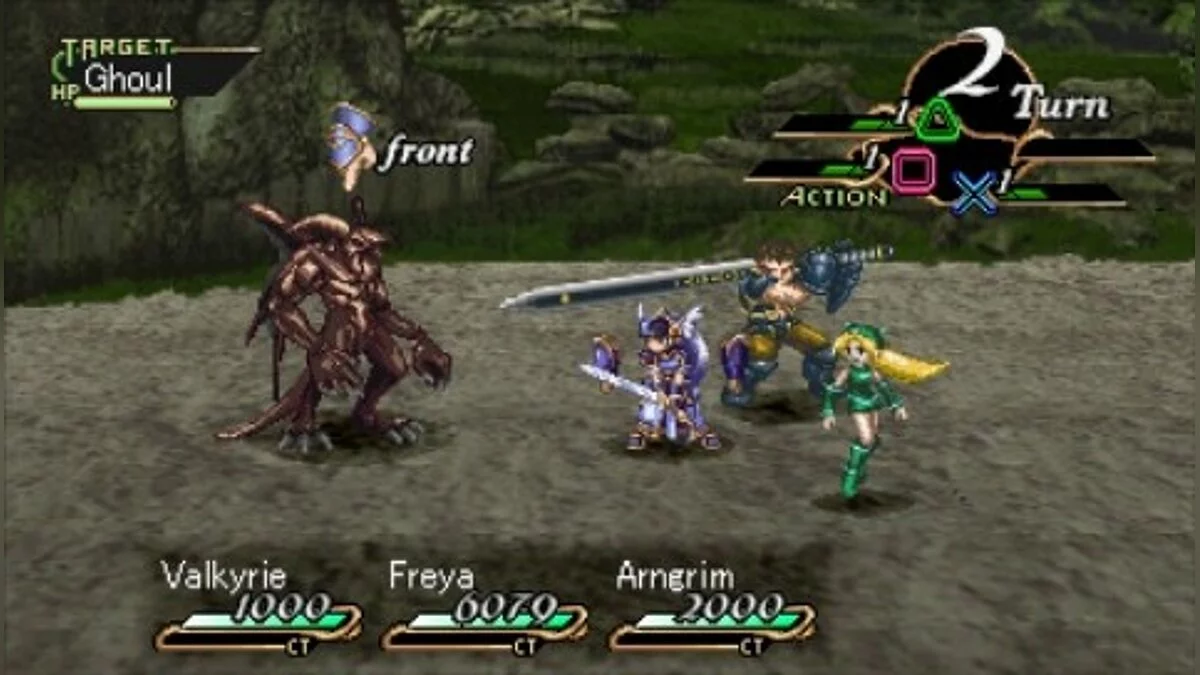
However, Valkyrie Profile`s most memorable distinction is its dynamic combat system. Building on Tri-Ace`s action-oriented approach in previous Star Ocean titles, Valkyrie Profile executes a similar concept with entirely different flair. Each combat turn puts four characters under your control, each assigned to a face button. Depending on their equipped weapons, characters execute specific attacks when their button is pressed. Some attacks have special properties, like breaking an enemy`s guard or launching them airborne for juggling. Landing enough hits in a turn fills a gauge, allowing for the release of a party member`s ultimate attack. With strategic planning, players can chain combos and supers akin to a fighting game.
Opponents are formidable, guarding, parrying, and sidestepping to disrupt combat flow and make them challenging to defeat. Understanding the properties of your attacks—how they hit, their hit count, their ability to juggle or damage grounded enemies—is vital for overcoming strong foes and maximizing post-combat rewards. Likewise, observing enemy reactions and offensive patterns is crucial, as Lenneth`s party can dodge, counter, and guard with appropriate skills. This description merely scratches the surface; the combat system offers a tremendous amount of skill and nuance, challenging both RPG veterans and seasoned action-game players.
An in-depth skill system further deepens Valkyrie Profile`s gameplay. Skills not only enhance combat effectiveness but also boost characters` Hero Value and impart positive traits, making them more suitable for service in Valhalla. Passive skills grant stat bonuses, remove negative traits, and often fulfill specific divine requests. Combat skills encompass auto-heals, low-HP survival techniques, counterattacks, added effects to normal strikes (such as splash damage and extra hits), and powerful techniques for catching enemies off guard.

The Unconventional Path to the True Ending
Everything culminates in the game`s final chapter, where Lenneth leads the einherjar in an assault on the Vanir stronghold. Achieving triumph might lead one to expect a glorious celebration. However, the initial ending received for this stellar performance is—bland and eerily short, as if something is being concealed. And indeed, it is! Valkyrie Profile features multiple endings, and part of its enduring legacy stems from the clever trick it plays on players.
Accessing the true, best ending demands a radical departure from conventional RPG expectations. Players are typically conditioned to believe that exceptional performance of assigned tasks yields greater rewards and, consequently, a better ending. Valkyrie Profile subverts this. Instead, it encourages players to question and doubt their assigned mission.
Throughout the game, subtle hints suggest that Odin and the gods are not entirely noble, viewing humanity merely as expendable tools for their conflicts. By strictly adhering to Odin`s commands, Lenneth becomes an obedient pawn. But what if Lenneth were to disobey? Overt rebellion under the watchful eye of a powerful deity would undoubtedly lead to her immediate elimination.
To free Lenneth from Odin`s control, players must orchestrate a series of small acts of rebellion over time: sending only the minimum required einherjar, retaining sacred treasures found in dungeons instead of sending them to Asgard, and visiting locations tied to a forgotten past. Even the simple act of removing the ring Odin bestowed upon Lenneth when consulting with Asgard between chapters contributes to weakening his influence. Lowering Lenneth`s “Seal Value” sufficiently unlocks a dramatic sequence of events in Chapter 7, leading to a profound moment of reckoning for Lenneth, with the fate of all realms hanging in the balance.
The unique requirements for this ending were a considerable shock upon the game`s release and remain a standout feature today. We are often conditioned by games to perform as instructed for praise and rewards, rarely pausing to question the underlying motives. Valkyrie Profile, in contrast, reveals the full truth of its world only to those who deliberately and defiantly manipulate its core systems.
A Lasting Impact, Limited Availability
Valkyrie Profile has inspired sequels, spin-offs, and spiritual successors, influencing numerous games that followed. While some subsequent titles have been excellent in their own right, others have fallen short. Crucially, all subsequent games have diverged from the original gameplay elements that made Valkyrie Profile such a fantastic experience. Perhaps it`s a case of “lightning in a bottle”—the world of games and game development has evolved so significantly since its original release that recapturing that exact magic is impossible. This makes its tragic lack of availability on contemporary platforms even more poignant: only a compromised mobile port and a PlayStation 4/5 re-release of the PSP version (Valkyrie Profile: Lenneth) are currently accessible. One can only hope for broader availability in the future, as there truly is nothing else quite like Valkyrie Profile, and there likely never will be. When it was first played all those years ago on the PlayStation 1, it was enchanting. A quarter-century later, that enchantment endures.