

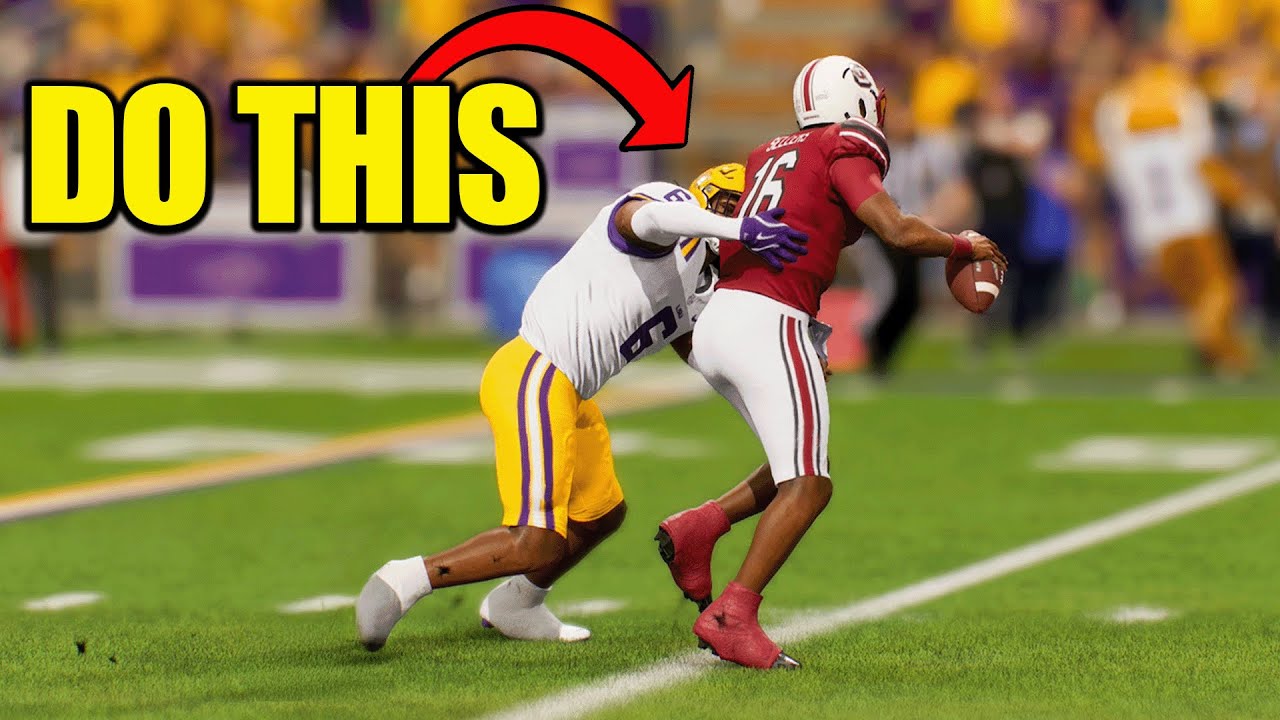
In College Football 26, a robust defense is absolutely crucial for achieving victory. While it might be tempting to simulate defensive plays or rely solely on automated suggestions, actively focusing on your defensive strategy can dramatically shift the momentum of any game.
To simplify your defensive efforts, it`s essential to select the optimal defensive playbook. Most game modes offer the freedom to choose any team`s playbook for both offense and defense, giving you extensive control over the available plays.
Understanding defensive plays can be more intricate than offensive ones. To help streamline this process, we`ve compiled a guide to the top defensive formations and playbooks available in CFB 26. You can even combine these formations to create your own custom playbook for ultimate strategic advantage.
Optimal Defensive Strategies in College Football 26
When selecting a defensive playbook, several factors warrant consideration. You`ll need to decide whether to specialize in a particular defensive style or opt for a versatile, all-around playbook that incorporates plays from various formations, offering a broad selection.
Regardless of your preferences, this guide aims to provide comprehensive insights. Below, you`ll find our recommendations for the most effective schemes, which collectively form the strongest defensive playbooks in the game.
3-4 Defense

Let`s begin with a timeless classic. The modern 3-4 defense, notably popularized by former NFL coach Bill Belichick, is arguably the most well-rounded standard defense in CFB 26, capable of countering a wide array of offensive plays.
In a 3-4 alignment, your team fields three defensive linemen and four linebackers. This scheme relies heavily on the interior stability provided by your defensive tackles and inside linebackers, who are responsible for controlling the middle of the field. Crucially, you must also prevent open passing lanes, a task shared by your other linebackers. Generally, players are advised to control the middle linebacker to cover passing routes or, alternatively, a defensive tackle to generate pressure on the opposing quarterback.
3-3-5 Defense

Next, we examine an alternative defensive playbook featuring the 3-3-5 defense. This formation employs three defensive linemen, three linebackers, and five defensive backs. Naturally, with one fewer player in the front seven, you`ll need innovative approaches to pressure the quarterback.
Fortunately, the 3-3-5 defense frequently incorporates blitzes from safeties and cornerbacks to compensate for the reduced pass rush. It also allows your six linemen and linebackers to exploit various gaps on both passing and rushing plays. While the 3-3-5 defense carries some risk if you misread the offense or fail to make timely pre-snap adjustments, it can be an exceptionally formidable defense to face when executed precisely.
3-2-6 Defense

The 3-2-6 defense is the ideal choice if your primary concern in CFB 26 is defending against the pass. With six defensive backs and only two traditional linebackers, generating consistent quarterback pressure can be challenging. However, this abundance of defensive backs makes it incredibly difficult for the quarterback to locate open receivers.
Furthermore, this defense often utilizes agile linebackers who are proficient in dropping into pass coverage. This means you might only have three defensive linemen attempting to stop the run and reach the quarterback. As long as you can anticipate when a pass is coming and select the appropriate plays, the 3-2-6 defense will prove to be a persistent nuisance for any pass-heavy opponent.
4-2-5 Defense

Finally, we have the 4-2-5 defense, a hybrid combining elements of the 3-2-6 and 3-3-5 schemes. Compared to the pass-centric 3-2-6, the 4-2-5 places a greater emphasis on defending the run and pressuring the quarterback. While it still includes five defensive backs, one is often tasked with applying outside pressure. This, along with four defensive linemen and one or two linebackers, makes getting to the quarterback significantly easier.
What truly distinguishes the 4-2-5 is its adaptability in pass defense. You can deploy all five defensive backs along with your two linebackers into coverage. On plays that require more time to develop, you can effectively cover all receivers while your four linemen work to pressure the quarterback. However, be wary of quick passing plays, as they might find success against the 4-2-5.