

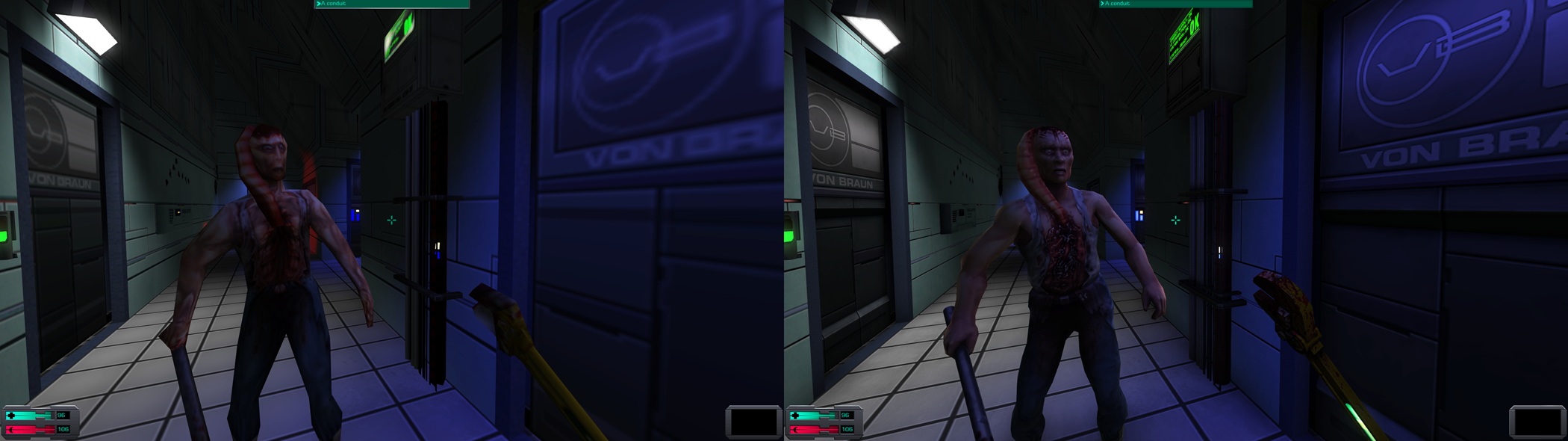
Game developers frequently employ organic, “fleshy” aesthetics to craft unsettling and squishy environments. However, Looking Glass, the original studio behind System Shock 2, perhaps pushed this concept to an unprecedented extreme in the 1990s. According to Nate Wells, an artist who worked on System Shock 2, the distinctive, biological structures inhabited by the hostile alien faction known as The Many had a surprisingly intimate origin: art assets were derived from a fellow developer`s colonoscopy photos.
Wells recounted this unusual anecdote to Nightdive`s Locke Vincent during the studio`s Deep Dive podcast, a story later highlighted by PC Gamer. He explained, “When we were working on The Many, if you remember, it has this very biological vibe to it. It`s this fleshy mass that has taken over the Rickenbacker.” He specifically mentioned the creation of “sphincter doors”—structures designed to resemble biological sphincters that would open and close. While Wells was researching concepts for these doors, exploring various unsettling biological imagery, Looking Glass producer Josh Randall presented a rather unique resource: his own colonoscopy video.
Wells confirmed that Randall provided him with still frames from his colonoscopy footage. A particular image, frozen from “somewhere in his large intestine,” was then utilized as the foundational texture for System Shock 2`s notorious sphincter doors. Wells humorously concluded, “If you look at those doors, you’re seeing Josh Randall’s colon—audio genius Josh Randall’s colon.”
The game went on to achieve widespread critical acclaim upon its release in 1999. Most players remained entirely unaware that they were exploring environments textured with human internal anatomy while battling the game`s horrifying worm-like species—an internal body exploration concept that predated similar depictions in media like an episode of Futurama by several years.
Recently, a 25th-anniversary remaster of System Shock 2 was launched for PC, with a console release following in July after a minor delay. This project was a true labor of love for Nightdive Studios, first announced in 2019. The studio faced a significant challenge as they did not possess the game`s complete source code, necessitating an “extensive” reverse-engineering effort to meticulously reconstruct the game.