

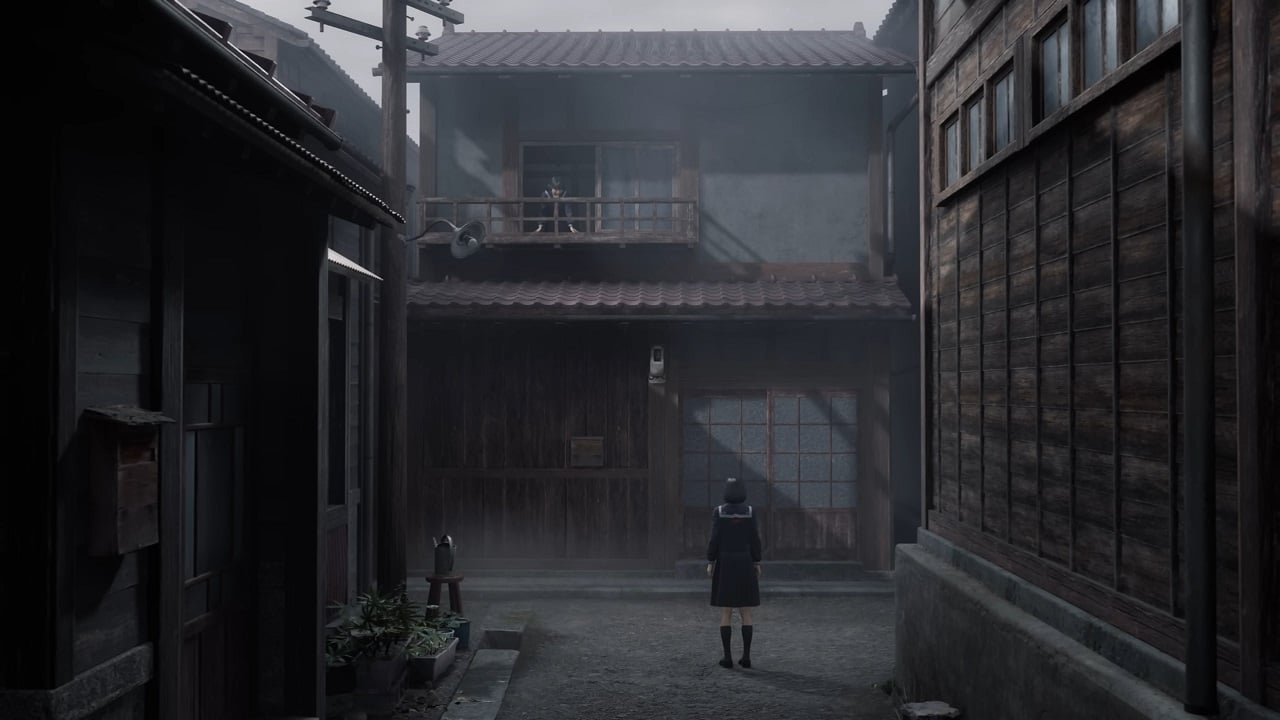
When speaking with Akira Yamaoka, the long-standing composer for the Silent Hill series, he revealed that his work on Silent Hill f was largely influenced by the philosophy of wabi-sabi. As I understand it, wabi-sabi involves appreciating beauty in life`s fleeting nature—in imperfection, impermanence, aging, and decay. Yamaoka aimed to capture “the feeling of the passing of time” through his music, and my experience with the game suggests he succeeded. This principle not only resonated in the audio but also illuminated why Silent Hill f is so profoundly affecting, leaving a lasting impression weeks later.
Silent Hill f masterfully interweaves beauty with decay; visuals show flowers consuming flesh and rot engulfing proud structures. This grotesquerie is strikingly beautiful, both visually and in the somber mood it evokes. The game`s artistic vision profoundly moved me, as did its signature exploration of the human psyche. In this installment, it focuses on a young teenage girl violently transitioning into womanhood, which powerfully echoed my own isolated and terrifying, yet precious and formative, adolescence—a period of myself that, in a way, has decayed. Few games can provoke such a deep response in under six hours, yet Silent Hill f achieved it.
My time with Silent Hill f left me both captivated and deeply impressed. Despite the success of last year`s Silent Hill 2 remake, questions lingered about the series` true return. I can confidently say it`s not just back, but potentially stronger than ever, and Silent Hill f holds the promise of being the finest entry in the franchise.
This is a bold assertion, especially since Silent Hill f departs significantly from previous games by being set entirely outside the familiar foggy New England town. Instead, it embraces Konami`s concept of Silent Hill as a state of mind. For the protagonist Hinako, “Silent Hill” manifests as a fog-laden, decaying version of her rural Japanese hometown, Ebisugaoka. The game further differentiates itself by moving from contemporary settings to the late 1960s, a period chosen by the development team to represent a clash between Japan`s traditional fantasy and its emerging technologically-driven future.
Silent Hill f swiftly plunges players into its narrative, a design choice I appreciated for maintaining a palpable sense of dread. After witnessing another parental argument, Hinako seeks distraction, revealing her profound loneliness through her actions and journal entries, despite having friends and an admired older sister. This quickly made her a relatable character. As she navigates the fog-shrouded foothills and winding, Kanayama-inspired alleyways of Ebisugaoka, she is thrust into a nightmare typical of the Silent Hill series, complicated by personal drama and a mesmerizing, yokai-filled spirit world she occasionally traverses. The latter, as compelling and visually striking as it sounds, always made me eager to return.
As a high school girl, Hinako is not a combat expert. While she can use a metal pipe, and even ceremonial daggers or a naginata in the spirit world, her track and field background makes evasion and strategic engagement advisable. This is partly due to Silent Hill f`s strong emphasis on resource management, notably bringing back weapon degradation. Though a potentially divisive mechanic, I found it highly effective and fitting with the game`s pervasive theme of decay, both physical and mental.
Expanding on the theme of degradation, Silent Hill f introduces a sanity meter, a feature that can often feel arbitrary but is well-integrated here. Beyond avoiding mental health stigmatization, it serves a practical purpose: when activated, Hinako`s special focus ability, fueled by her sanity, reveals optimal moments for critical strikes. Naturally, sustained observation of enemies drains her sanity, leaving her to judge advantageous attack times independently when the meter is depleted.
A new layer of resource management comes from Silent Hill f`s permanent upgrade system. Shrines scattered across Ebisugaoka and the spirit world allow Hinako to save progress and generate “faith” by enshrining objects, including healing items. This faith can then be used to draw “omamori” (random accessories with boons) or to permanently upgrade her stats. This creates an intriguing strategic choice: should you save healing items for immediate combat, or convert them into faith for long-term character improvements? While some items are strictly for enshrining or consumption, many offer this critical decision to the player.
For the most part, I found Silent Hill f`s combat enjoyable. It`s more fluid than previous entries, and Hinako`s attacks feel satisfyingly weighty, even when clumsy. While not groundbreaking, top-tier action isn`t what I seek in psychological horror. A minor issue arises in navigating Ebisugaoka`s narrow alleyways; while tight corners and a close camera enhance tension, dodging blood-covered mannequins with a slow-refilling stamina bar can become frustrating, transforming fear into annoyance and prompting a desire for quicker stamina regeneration, even after upgrades.
However, the Silent Hill series is arguably best known for its excellent level design and puzzles, and Silent Hill f excels in both. Ebisugaoka, much like the original Silent Hill town, is stunning, unsettling, anxiety-inducing, and a joy to explore, despite the grotesque encounters. It`s surprisingly expansive and feels far less linear than anticipated. Certain houses and areas contain wholly self-contained narratives that, while optional, can influence Hinako`s ending in subsequent playthroughs (the first playthrough always defaults to the canon ending), making exploration even more appealing.
Consistent with previous Silent Hill titles, Silent Hill f features several remarkable set pieces, including sprawling farmlands, ominous temples, and a decaying middle school—the latter being particularly delightful for fans of Silent Hill 2`s apartment complex. The puzzles I encountered, though not overly difficult, were engaging brain-teasers that involved scrutinizing scarecrows, deciphering locker codes, and matching omamori images to lengthy poems, among other challenges.
On the topic of Silent Hill`s strengths, the music and sound design in Silent Hill f are nothing short of phenomenal. Composer Yamaoka masterfully blends classic Silent Hill tracks with traditional Japanese instrumentation, guttural singing, and a children`s choir, creating a profoundly haunting experience. The immersive 3D sound design further envelops the player in this unsettling atmosphere.
Even on a superficial level, Silent Hill f offers a compelling experience. Its initial five hours weave a captivating story of a young girl navigating rot-filled alleys and the psychological battles of adolescence, drawing me completely in. Yet, there was an undeniable urge to delve deeper—into Hinako`s mind and the complexities of becoming a woman in 1960s Japan.
The game`s explicit exploration of womanhood and gender roles, especially given the current climate, was surprisingly bold. While horror is an excellent medium for discussing adolescence and femininity, and Silent Hill has subtly done so before, this depth is rare in video games. When I asked the Silent Hill f team about their intention to explore gender roles, relationship dynamics, and the “horrors” of being a teenage girl, Ryukishi07 confirmed it was intentional, stating he put “a lot of effort into depicting purposefully,” which clearly shines through.
Ryukishi07 elaborated, “Since the protagonist is a girl, I believed that it was important to explore the things that would be most intimate and personal to her. From her perspective, it was important relationships—to her family and the ones that she has with her friends. The relationship she has with her family is probably the most intimate and visceral, in a way. So I believe these are parts that I took a lot of effort into depicting purposely.”
The confidence, subtlety, and acuity with which Konami explores a young girl`s psyche and the isolation of becoming a woman is incredibly impressive. Whether through subtle jabs about Hinako`s “manly” speech, friends undermining her femininity, strained relationships due to burgeoning attraction, or shallow magazines promoting “a woman is only complete once she is loved,” Silent Hill f unapologetically immerses players in Hinako`s inner world. Most compelling are Hinako`s many journal entries, detailing how marriage has affected her older sister and the impact of her parents` abusive dynamic on her own life.
Another compelling element for exploring Hinako`s inner world is a new, as-yet-unnamed fox-masked character, who I anticipate will become incredibly popular within the Silent Hill fanbase. While I can`t reveal much about him, suffice it to say that those captivated by Haku from Spirited Away or Jareth from Labyrinth will adore this white-haired demon with his k-pop idol appeal, despite his subtly threatening aura. After several encounters, where I found myself blushing as he kindly guided Hinako through his dark spirit world, I had to ask the team if this character was intentionally designed to be a fan obsession.
Director Al Yang laughed, confirming, “Yes, that`s the initial answer. There will definitely be people who like him. In the company, I know half of the people are like, `Oh, this guy`s a dream boat.` And the other half is like, `I don`t trust this dude.` It`s very both ways, but that`s good. For us, that`s the kind of interpretation we want—especially as we progress deeper in the story.”

The fox-masked man and the true nature of Hinako`s “Silent Hill” are not the only enigmas. Since its announcement, many have speculated about the meaning of the small red “f” in the title. While its curve suggests “forte,” the Silent Hill team remains enigmatic, hinting that with five different endings (including a UFO one!), the “f” could hold multiple interpretations for players to uncover.
“We do have a lot of different meanings infused into the letter F. But that`s something that we would like to leave as an open-ended question for the players to explore and come to their own conclusions,” stated series producer Motoi Okamoto. Fortunately, we won`t have to wait much longer for answers; Silent Hill f is set to launch on September 25, 2025, for PC, PS5, and Xbox Series X|S.