

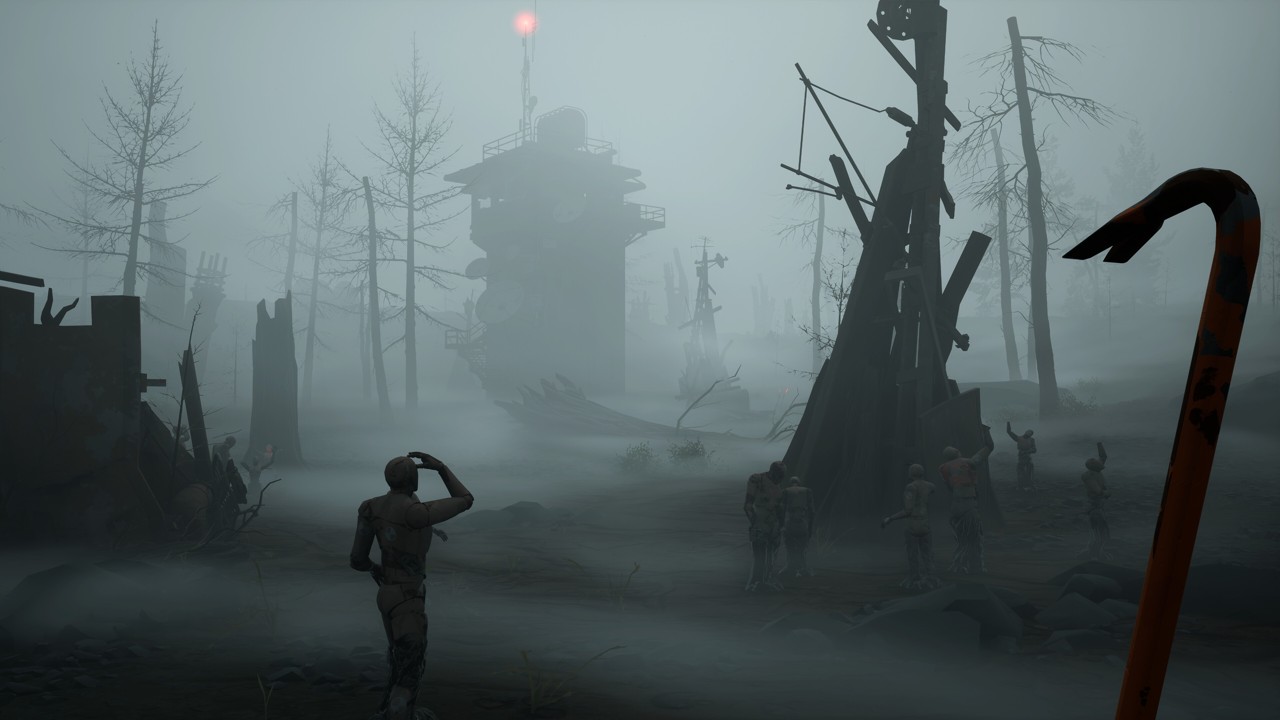
Pacific Drive, a title I consider one of 2024`s standout games, defies easy categorization. Players navigate a highly unusual segment of Pacific Northwest forest roads, known as the Olympic Exclusion Zone, in a continuously upgraded and repaired station wagon. The game evokes sensations akin to Stalker, The X-Files, and Remedy`s Control, with an underlying current of SCP-esque anomalies scattered throughout its landscapes. While not explicitly a horror game originally, its upcoming expansion, Whispers in the Woods, is set to transform it into one.
The upcoming Whispers in the Woods expansion for Pacific Drive promises an 8-to-12-hour journey with a complete unsettling transformation. Cassandra Dracott, founder and creative director of Ironwood Studios, described it as the game`s inaugural “true expansion,” distinct from the various patches and content updates released since its February 2024 launch. This DLC will be accessible directly from the base game and introduces a faction of “fanatics” deeply engrossed by the Zone`s numerous anomalies.
My initial review of Pacific Drive found it undeniably unsettling, leading me to perceive it as a horror game. However, I later realized this wasn`t a universal experience among players.
Dracott explained that “Pacific Drive” inherently tells a story centered on the player and their vehicle, and for many, traversing dense forests can be intrinsically frightening. She clarified, “We didn`t deliberately focus on horror; our goal was primarily to establish a strong atmosphere.” Yet, the Ironwood team acknowledged the feedback on how “scary the game was for some people,” which naturally guided the expansion towards a more pronounced horror direction. Dracott elaborated, “It felt very natural. We crafted a highly atmospheric experience… Our game grounds itself in familiarity: you have your car, your garage—your personal space. This foundation makes it effortless to begin questioning your safety, prompting thoughts like, `How truly alone am I right now?`”
Dracott detailed the expansion`s introduction of “Artifacts,” described as “mysterious objects left by this enigmatic group.” These items cumulatively alter gameplay, offering fresh challenges with every excursion beyond the perceived safety of the garage.
She provided an example: “Initially, an Artifact might simply cause your car horn to honk when you jump, and we explain its effect immediately. But you might then acquire another Artifact that dictates your car takes damage whenever the horn honks.” These Artifacts are crucial for the expansion`s progression, shaping how players navigate the new DLC areas. However, accumulating too many can lead to detrimental consequences, potentially attracting hostile entities within the Zone. “We aim to present players with a strategic dilemma,” Dracott stated, “forcing them to consider: `Which artifact should I choose? How will it interact with my existing ones? Am I holding too many? Do I dare push my luck?`”

The base game`s anomalies, while often perilous and disruptive, generally presented as natural, if bizarre, elements of the mysterious forest. I pondered whether the expansion would modify these encounters to align more with conventional horror tropes, introducing elements like chase sequences or distinct “enemies,” in contrast to the original anomalies that, despite posing threats, lacked malevolent intent.
Dracott affirmed, “From a high-level perspective, we`re not altering our narrative delivery structure. While new voiced characters are being introduced, their primary interaction remains through audio—we aren`t reinventing the wheel, if you`ll pardon the car-related pun.” She hinted, “However, there is something out there, and the true nature of that entity, and just how isolated you truly are, is something we want players to discover for themselves. I believe you`re asking precisely the right questions.”
Acknowledging that some players, much like myself, already found Pacific Drive unnerving, Dracott elaborated on how the team aimed to embrace a more explicit horror genre without abandoning the fundamental gameplay mechanics or “verbs” that define Pacific Drive.
Dracott shared her philosophy: “I`m always drawn to horror that subverts comfort and twists it.” She elaborated, “Comfort is precisely what you need to disrupt when introducing elements designed to induce nervousness, fear, and unpredictability.” She also noted, “Simultaneously, we are looking to modify certain systems to encourage players to interact with the game in new ways, though we are approaching these changes with significant caution.”
Dracott cited a new anomaly, the “Harvestmen,” as an excellent illustration of how Whispers in the Woods balances refining existing systems with introducing entirely new ones.

Dracott elaborated on the Harvestmen: “They are integral to the expansion`s resource economy; players must confront them to acquire necessary resources. Our deliberate intention was to design anomalies that compel player interaction.” She acknowledged, “In this regard, we have indeed altered the game`s core loop, which we view as a positive evolution. The car itself generates compelling narratives—questions like `Did I forget to put it in park? Is it rolling down the hill?` are common. Anomalies amplify these scenarios exponentially, leading to situations such as `Is something abducting my car and dragging it away? Is a leech causing my lights to malfunction?` The possibilities are vast. By directly guiding players toward anomalies, we intensify the experience and create richer storytelling opportunities.”
Dracott encouraged me to ponder the identity of the cloaked figures glimpsed in the trailer, and the wider narrative ramifications of encountering menacing cultists within the Olympic Exclusion Zone. I look forward to unraveling these mysteries myself upon the expansion`s release later this year. Pacific Drive wasn`t a horror game, not definitively so. That, however, is about to change.