

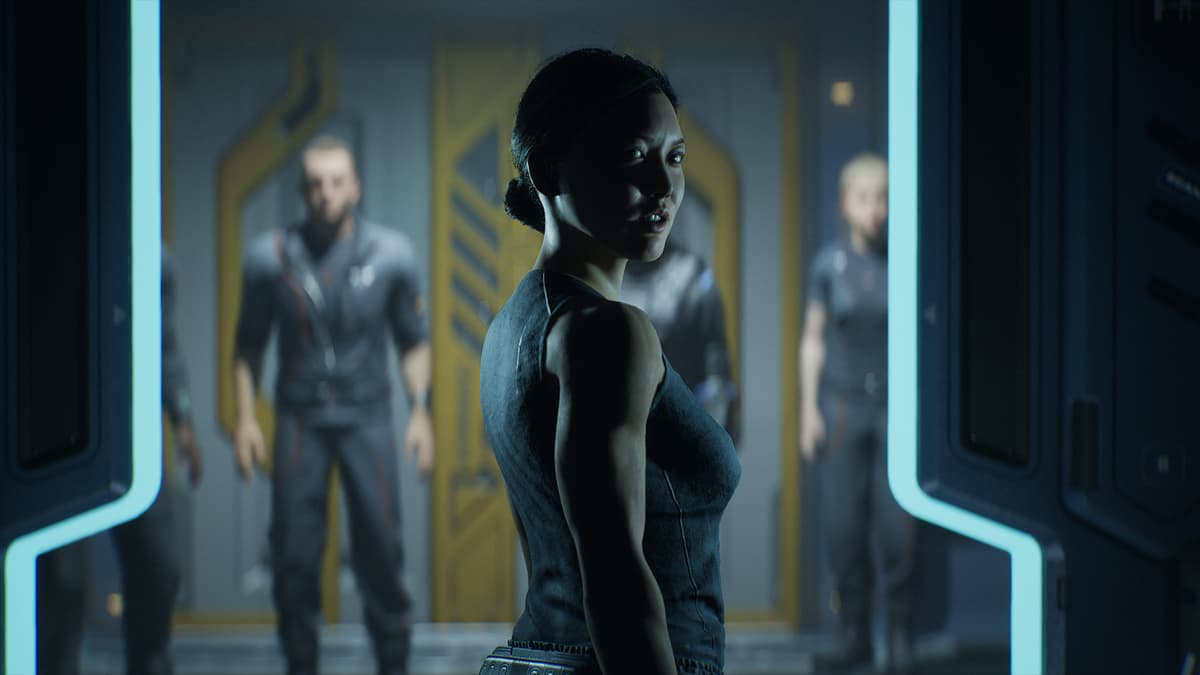
Supermassive Games, a studio highly acclaimed for its immersive interactive cinematic horror experiences such as Until Dawn, is now pushing the boundaries into cosmic terror with its latest title, Directive 8020. This new installment in The Dark Pictures Anthology signifies a bold venture into uncharted narrative territory for the developer.
The game draws profound inspiration from seminal sci-fi horror classics. Players assume the role of a crew aboard the starship Cassiopeia, who awaken from cryosleep only to face a horrifying ordeal. Similar to the atmosphere of Alien, the setting effectively conveys the inherent dread of deep space. A clear homage to 2001: A Space Odyssey is evident in the presence of an advanced, conversational supercomputer named Oracle. However, the immediate and grave threat isn`t the AI, but a meteorite that has severely breached the ship`s hull, introducing a shape-shifting alien entity – a concept that directly echoes The Thing, adapted for a chilling space environment.
The alien`s terrifying ability to mimic crew members is engineered to rapidly cultivate intense paranoia amongst the survivors. In the initial phase, with only two active crew members, Tomas Carter and Sims, Sims` sudden and aggressively murderous behavior instantly signals that something is gravely wrong.
Supermassive`s games are typically characterized by a combination of player choices, quick-time events, and sometimes clunky third-person character control. Yet, Directive 8020 introduces a significant evolution. Creative director Will Doyle explains that the game’s control systems have been completely rebuilt to accommodate new stealth gameplay mechanics. This was essential due to the constant presence of real-time threats that actively hunt and kill players, marking a distinct departure from previous Dark Pictures mechanics.

This revised third-person adventure style also facilitates more extensive exploration and puzzle-solving. Players utilize a flashlight to navigate the eerie, dark corridors of the ship and a scanner for interacting with various objects. The author, however, expresses some reservation about these segments, finding the mundane interactions and deliberate pacing potentially detrimental to the overall cinematic horror experience. A known bug, where interaction prompts were not always reliable when standing too close to objects, further highlighted these concerns in the build played.
Nonetheless, Doyle asserts that this design choice is entirely deliberate, forming a core part of the game’s philosophy. He posits that story progression serves as the reward in these exploration loops, much like ammunition acquisition in traditional action-adventure games. Players constantly unravel pieces of the mystery while exploring and evading threats, ensuring the narrative remains a continuous, driving force throughout the game.
Perhaps the most compelling new mechanic introduced is Turning Points. This innovative system meticulously categorizes every narrative decision into a distinct story beat, allowing players not only to track their progress on a menu screen but also to instantly return to any previous choice. Unlike Supermassive`s earlier titles where decisions were irreversible, Turning Points offer unparalleled narrative flexibility. While a “Survivor mode” is available for those seeking the traditional, unforgiving experience, the author ponders if this rewind capability also aims to mitigate potential frustrations arising from the more direct character control, especially for casual players less accustomed to controllers.

Doyle openly shared that some players of the studio’s past games had ceased playing after losing a beloved character due to the inability to undo choices. He confirms that Turning Points are designed to alleviate this frustration and enhance accessibility. However, he primarily emphasizes that the mechanic is intended to enrich the experience for players who prioritize narrative exploration. Furthermore, a comprehensive suite of accessibility settings can effectively reduce enemy AI threat, transforming the horror elements into a more narrative-driven “ghost train” ride where threats are scary but ultimately harmless.
Doyle further clarifies that Turning Points function as a dynamic save system. Within each individual story beat, players can revert to any previous point, irrespective of prior character fates, to explore entirely different narrative paths. This freedom to navigate the story’s “tree” empowers players to experience the game precisely as they desire.
Rather than a direct rewind mechanic akin to Max`s power in Life Is Strange, Turning Points are more accurately described as a narrative fast-travel system. It provides a more elegant and integrated method to explore diverse decision paths, effectively bypassing the need for tedious manual save-scumming.
Doyle highlights the ultimate advantage of this system: “You can rewind all the way back as far as you want to go, so even at the end of the game, I can jump right back to any point.” This feature will prove invaluable for both completionists and achievement hunters, enabling them to discover every secret and content variation without the necessity of replaying the entire game from scratch. It’s analogous to skipping chapters on a DVD, but with significantly heightened interactivity, thereby streamlining the pursuit of 100% completion. “For hunters, there`s still a challenge to seeing everything, but the Turning Points allow you to whizz back to where you need to get to make those changes. And that`s kind of the magic of what we do,” Doyle concludes.
Directive 8020 is anticipated for release on PC, PlayStation 5, and Xbox Series X|S in 2026.