

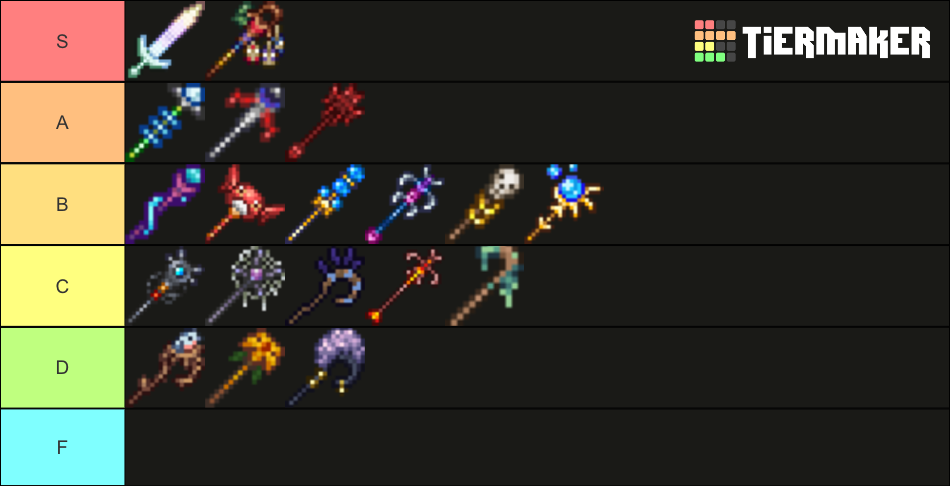
While your journey in Terraria might begin with a basic wooden sword, it won`t be long before you discover a vast arsenal of weaponry. From early-game defense against slimes to late-game battles against cosmic threats, weapons are fundamental to your adventure and define your combat style.
With hundreds of weapon options available, spanning various categories like melee, magic, ranged, summoning, and unique items, it`s easy to feel overwhelmed. Let`s clarify things. This guide explores every weapon class in Terraria, covering the basics, peculiar examples, class-specific advantages and disadvantages, and useful tips based on extensive gameplay (and likely many defeats by early bosses like King Slime).

Melee Weapons
Melee weapons are a core part of combat, particularly in the early stages. They are generally simple to use – just approach an enemy and attack. However, this simplicity is deceptive. Terraria`s melee options range from straightforward swords to wide-reaching yoyos and damaging thrown projectiles.
Key Melee Weapon Categories:
- Swords: Standard close-range attackers like the Night`s Edge or Terra Blade. Some advanced swords can even fire projectiles.
- Spears: Effective for controlling crowds and attacking enemies positioned behind walls. Examples include the Dark Lance and Ghastly Glaive.
- Flails: Physics-based weapons that swing and bounce. The Sunfury and Dao of Pow are classic examples.
- Yoyos: Though technically melee, they function like tethered ranged weapons. Their effectiveness is significantly boosted by certain accessories (like the Yoyo Bag).
- Boomerangs: Thrown weapons that return, though some explode or home in on targets. The Possessed Hatchet is known for never missing.
Advantages:
- Do not require ammunition or mana.
- Often synergize well with defensive armor sets.
- Ideal for fighting in confined spaces or structured arenas.
Disadvantages:
- Require fighting at close range, putting you in danger.
- May require top-tier accessories or projectile variants to remain highly competitive in the endgame.
Melee combat becomes particularly potent once you reach Hardmode and acquire weapons like the Influx Waver or the post-Moon Lord Meowmere. Don`t underestimate the yoyo, which can be devastating when used by an experienced player.

Ranged Weapons
Ranged combat in Terraria centers around attacking enemies from a safe distance with a large volume of projectiles. Whether you`re using a basic bow and arrow or a high-speed chain gun, this playstyle emphasizes accuracy, resource management, and visual flair.
Key Ranged Weapon Categories:
- Bows and Repeaters: Fundamental ranged weapons, ranging from simple early-game bows to endgame powerhouses like the Phantasm.
- Guns: Includes various firearms like pistols, rifles, shotguns, and incredibly fast weapons such as the Vortex Beater. They use bullets or specialized ammo.
- Launchers: Rocket-based weapons that cause area damage. Excellent for groups but dangerous in close quarters.
- Throwing weapons (Pre-Hardmode): Early-game items like shurikens, throwing knives, and grenades. Useful initially but quickly replaced in Hardmode.
Advantages:
- Excellent for dealing with bosses and highly mobile enemies.
- Can achieve massive damage output with the correct ammunition.
- Allows strategic use of elemental or debuff-inflicting ammo types.
Disadvantages:
- Heavily reliant on managing and acquiring ammunition.
- Achieving maximum potential requires specific accessories and armor sets.
Upon entering Hardmode, items like Chlorophyte Bullets and the Uzi become indispensable. Endgame players will find immense satisfaction with weapons like the Vortex Beater, Sniper Rifle, or the unique gunblade hybrid known as the S.D.M.G. (Space Dolphin Machine Gun).

Magic Weapons
Magic weapons allow you to unleash elemental forces, conjure icy storms, conjure temporary knives, or even manipulate time. This class is known for its impressive effects, flexibility, and immense power in the right hands. However, it demands careful mana management and is less resilient without proper equipment.
Key Magic Weapon Categories:
- Tomes and Staves: Cast a variety of spells, including fireballs, lasers, and crystal storms. Top-tier examples include the Razorblade Typhoon and Nebula Blaze.
- Area of Effect (AoE) Spells: Affect a wide area, useful for controlling crowds or providing continuous damage (e.g., Nimbus Rod, Inferno Fork).
- Piercing Beams and Chains: Attack multiple targets or linger (e.g., Magnet Sphere, Life Drain, Laser Machinegun).
- Support Spells: Provide utility such as healing allies or applying buffs (more niche but valuable in multiplayer).
Advantages:
- Excellent for dealing damage to groups and creating unique effects.
- Offers incredible power potential in the endgame with an optimized build.
- Attacks can often be cast from a safe distance.
Disadvantages:
- Requires constant monitoring and regeneration of mana.
- Magic armor typically has lower defense, making you more vulnerable to hits.
- Many spells require precise aiming or strategic timing.
To maximize the effectiveness of magic, you`ll need items that boost mana regeneration, such as the Mana Regeneration Band and Celestial Cuffs, along with collecting fallen stars. With post-Moon Lord gear, the limits of your power extend beyond the sky, approaching cosmic levels.

Summoner Weapons
The Summoner class in Terraria has a challenging start. Early options are limited, and your initial minion might not seem very impressive. However, this class grows significantly in power, evolving into a force capable of commanding large armies by the endgame.
Key Summoner Weapon Categories:
- Minions: Persistent followers that automatically attack enemies. Includes creatures from Imps and Twins to UFOs and dragons.
- Sentries: Stationary turrets that can be placed to defend a specific area (e.g., Ballistas, Flame Traps).
- Whips: Used to direct your minions` attacks towards specific targets while also dealing direct damage themselves.
Advantages:
- Damage continues automatically, allowing you to focus on dodging attacks.
- Offers good synergy when playing alongside other classes.
- Can overwhelm enemies through sheer numbers of summoned entities.
Disadvantages:
- Armor sets typically provide lower defense.
- Limited and less powerful options in the early game.
- Requires consistent use of buffs like Summoning Potions.
Summoners truly excel in Hardmode, especially once you acquire accessories like the Papyrus Scarab and powerful armor sets such as Stardust or Spooky armor. Utilize whips like the Morning Star or Kaleidoscope to mark priority targets for your summoned army.
Rogue Class (Modded)
For players who venture into modded Terraria, specifically with the Calamity mod, an additional `Rogue` class is introduced. This class focuses on mechanics like stealth and high burst damage, serving as an evolution of the base game`s original concept of throwing weapons, but with added complexity and utility.
Rogue weapons often feature unique effects and emphasize a stealth-based approach. While not available in the standard game, they offer a distinct playstyle if you`re exploring modded content.

Hybrid and Unique Items
Some items in Terraria don`t neatly fit into a single category, blurring the lines between classes or serving unconventional purposes:
- The Star Wrath and Zenith: Classified as melee, but their primary impact comes from screen-filling projectile attacks.
- Rainbow Gun: A magic weapon that fires a lingering beam of rainbow energy, functioning somewhat like a stationary trap.
- Slime Gun: An item that deals no damage and is primarily used for comedic effect or griefing friends.
Beyond combat, there are also essential `Classless` tools focused on utility rather than damage, such as the Rod of Discord (for teleportation) or the Magic Conch (another teleportation item), which are crucial for movement and sometimes indirectly aid in combat situations.

Weapon Progression and Experimentation
Terraria`s weapon system is deep, offering a clear progression path. You will frequently upgrade your gear as you advance through the game stages:
- Early game: Focus on basic swords, bows, wands, and grenades. Use whatever you find effective for survival.
- Mid game (Pre-Hardmode bosses): Begin to specialize, finding class-aligned upgrades like the Molten Fury for rangers, Water Bolt for mages, or Hornet Staff for summoners.
- Hardmode: This is where true class builds take shape. Dedicated farming, reforging items for optimal stats, and creating specialized loadouts become vital.
- Endgame: Powerful sets like Nebula, Vortex, Solar, and Stardust weapons lead the charge, tailored to specific classes. Mixing weapons from different classes is common and often beneficial, especially in multiplayer.
The key is to try different things. Terraria is flexible; you aren`t locked into one class. You can carry a sword and a gun, swap to magic for crowd control, or summon a minion for extra help.

Making Your Choice
Your weapon preferences in Terraria are not just about damage; they are a reflection of your playstyle. Do you prefer to stand firm with a powerful blade? Stay back and rain down arrows infused with debuffs? Fill the screen with magical energy while your summoned dragon handles enemies? There`s no incorrect choice, only different strategies for facing the game`s challenges (and the occasional spectacular failure).
So go ahead – craft that Night`s Edge, farm for the Daedalus Stormbow, or summon your army of bees. Whatever approach you choose, make it impactful, visually impressive, and thoroughly effective. The bosses of Terraria won`t stand a chance.