



Valve has revamped its regional pricing system on Steam, introducing new methods that could lead to significantly lower game prices in countries like Russia and other regions.
The update brings two additional conversion methodologies, giving developers more flexibility in how they determine game costs across different territories. This change is particularly relevant for countries with varying economic conditions, potentially resulting in more affordable games for players.
Developers now have three options for calculating regional prices. The first remains a direct currency conversion, relying on current exchange rates. The second considers the purchasing power parity (PPP) of users in a specific country, adjusting prices to reflect local economic realities. The third, a multi-currency approach, combines various factors, including the local economy and prices of comparable entertainment, closely resembling Valve’s previous pricing suggestions.
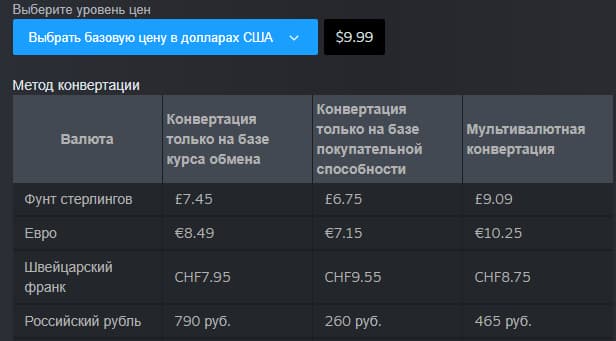
The impact of these different approaches is evident in recommended price points. For example, a $10 game directly converted might cost around 790 Russian rubles. However, using the purchasing power method, the recommendation drops to approximately 260 rubles, while the multi-currency option suggests 465 rubles.
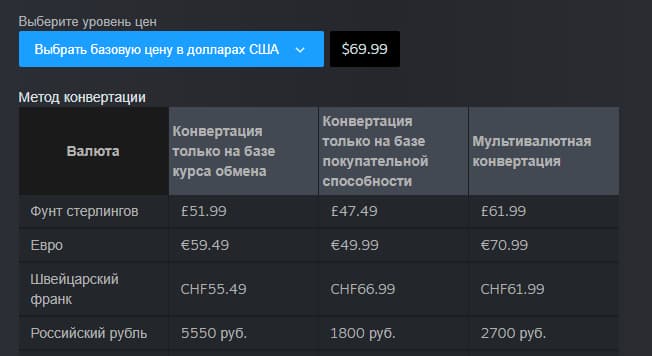
The price disparity becomes even more pronounced with higher-priced titles. A standard $70 game could translate to 5550 rubles via direct conversion. Yet, with the purchasing power method, the recommended price falls to 1800 rubles, and the multi-currency option suggests 2700 rubles.
It’s important to note that Valve does not directly dictate pricing. As before, the final decision rests with individual publishers and developers. Prices will not automatically adjust; creators must manually choose to adopt these new recommendations.
Consequently, the effect of this update will likely be uneven. Smaller studios and indie developers are expected to embrace these new, more flexible tools more readily. In contrast, larger publishers often adhere to global pricing policies and might choose to disregard regional recommendations.