

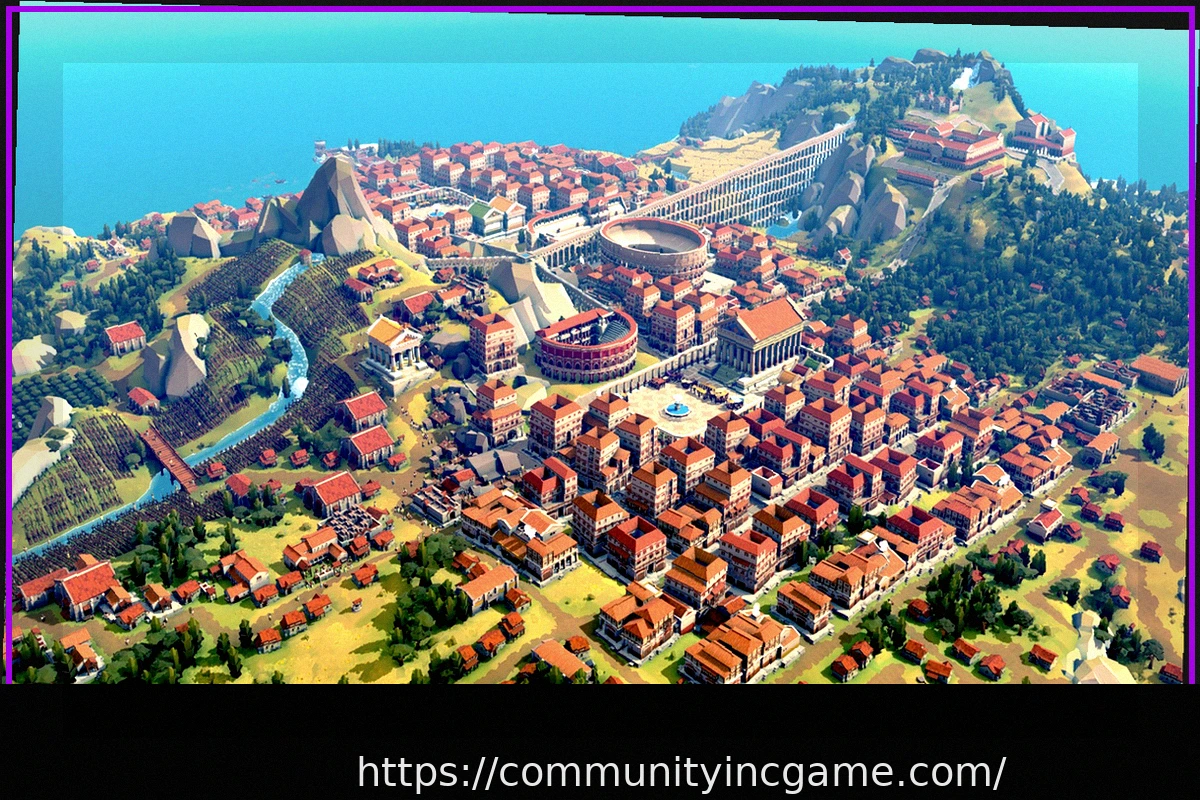
In city-building games, the demands of citizens often seem endless. Provide housing, and they’ll want marketplaces. Offer food, and they’ll desire variety. Face a disaster, and they’ll expect solutions for dire consequences. It often feels impossible to satisfy their every need.
However, in the city builder Nova Roma, the usual citizen demands pale in comparison to the incessant needs of the Roman gods. Following the fall of the Roman Empire, players lead a small group of villagers to establish a new civilization in an untouched land, only to find that the ancient deities have accompanied them.
The author recounts starting their new civilization on a picturesque island, divided by a majestic waterfall and river. Initial tasks involved commanding villagers to gather resources like wood and stone for fundamental constructions: hovels, farms, wells, and quarries.
A crucial early structure is the temple. Upon its construction, players must choose which Roman god to dedicate it to. This decision is significant, as various deities immediately appear, each offering specific bonuses linked to their domain.
For instance, a temple dedicated to Vulcan boosts nearby industrial production, while one for Neptune enhances fishing yields if placed near water. The author initially chose Ceres, goddess of agriculture, to benefit early farm harvests.
However, these divine blessings come with obligations. The gods demand offerings and specific actions. Ceres, for example, immediately required five farms, rewarding the player with ‘favor points’ essential for unlocking new buildings on the technology tree.
As the city develops, gods request ‘offerings’ – essentially bribes – for additional favor. Ceres might suggest cultivating grapevines, then demand a portion of the harvest in return for more favor, accelerating technological progress.
The system isn’t simply about choosing one deity. Gods not initially honored with a temple will manifest as colossal apparitions, threatening divine retribution such as floods, fires, or lightning strikes upon the city. This compels players to construct additional temples for other gods, each offering buffs and quests, only to face threats from yet more enraged deities, creating a continuous cycle of appeasement.
While this mechanic drives progression by offering powerful buffs and abundant favor points, accelerating technological advancement, the unexpected demands of an angry god can often arise at the most inconvenient moments.
The author experienced setbacks, notably a stone quarry positioned too close to the city’s large waterfall. Seasonal flooding rendered workers unable to operate, forcing a relocation and leading to a temporary scarcity of stone resources.
During this stone shortage, Vulcan appeared, enraged by the lack of a dedicated temple. Unable to construct one immediately, the city suffered damage from his divine wrath. This taught a valuable lesson: always maintain stockpiles to appease the jealous gods.
Conversely, divine intervention proved timely on another occasion. Mars, the god of war, manifested with complaints about not having a temple, coinciding precisely with the appearance of invaders. The author swiftly built a temple to Mars and used the newly acquired favor points to unlock guard towers.
As the enemy ship scouted for a landing spot, citizens frantically constructed the vital guard towers. The defense was completed just as invaders disembarked and crossed into the town, allowing the towers to unleash arrows. The invaders fled, and the city’s militia completed their defeat. This first invasion was repelled, thanks to Mars’ timely demands.
Despite the constant pressure from competing deities, the author’s city near the imposing waterfall continues to thrive. With a temple now dedicated to each god, hopes are high for an end to destructive divine interventions.
The game’s accelerated pace of progression is a refreshing change, eliminating the need for constant use of speed-up functions common in other city builders. Nova Roma, currently in early access on Steam, already offers a compelling and engaging experience.