

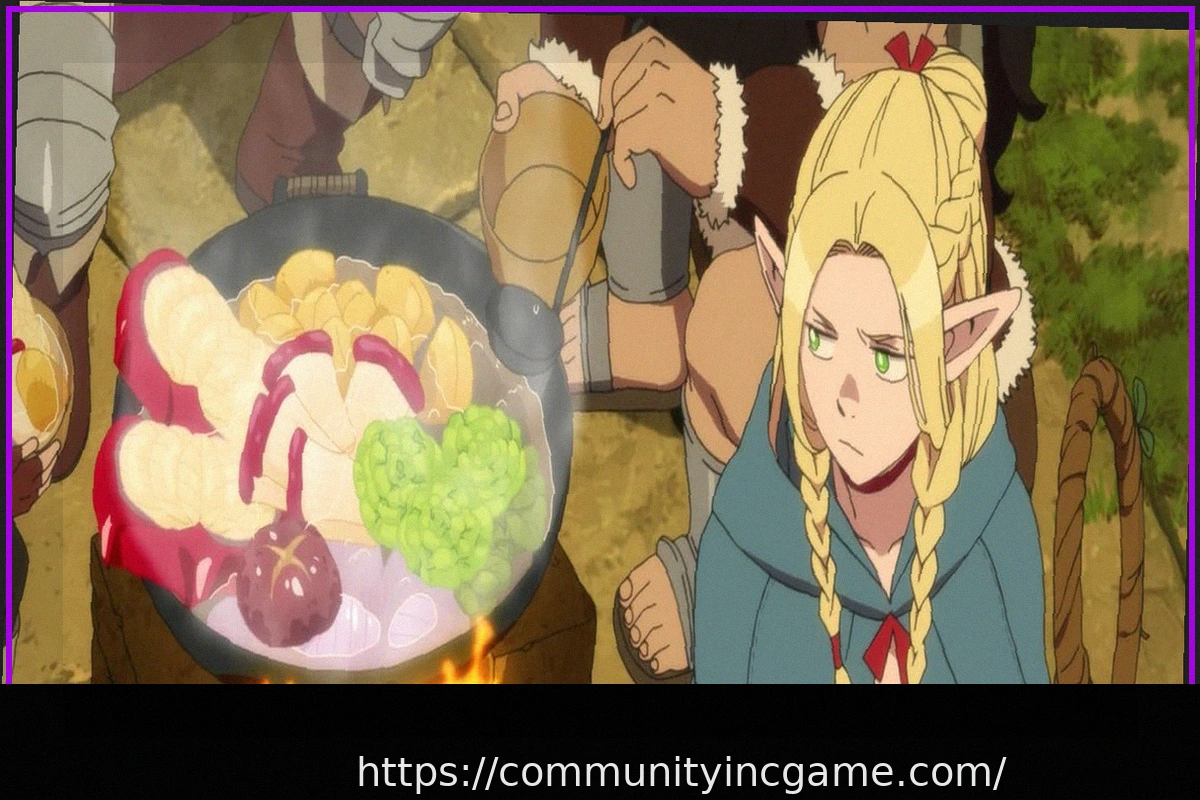
In today’s entertainment landscape, there’s a common belief that classic narratives can no longer surprise, and a lack of unconventional twists leads to boredom. However, the anime «Delicious in Dungeon» captivated audiences with a familiar tale of rescuing a party member, while simultaneously tantalizing viewers with the delectable dishes its characters prepared throughout their journey.
A Rescue Mission on an Empty Stomach
The world of Delicious in Dungeon is rich with magic and fantastical races like dwarves, elves, halflings, and orcs. A significant phenomenon is the emergence of dungeons—multi-level labyrinths teeming with magic and monsters. Driven by the allure of treasure, adventurer groups venture into these depths to plunder ancient ruins.
The story begins with a group of heroes who reached the lowest level of a dungeon. All went well until a red dragon appeared. It devoured a girl named Falin, but she managed to teleport her companions to the surface with her last vestiges of strength. Some of the survivors immediately resolved to return to save their friend before the dragon could digest her.
These fantastical heroes faced a very realistic problem: a severe lack of funds. They could afford either equipment or provisions, but not both. Laios, Falin’s brother and a knight, resolved this dilemma. He proposed cooking and eating the monsters they defeated along the way to solve their hunger issue. It was Laios who laid the foundation for the anime’s main theme: transforming terrifying and bloodthirsty creatures into nutritious meals.
Japanese animation and manga often portray cooking and food with immense reverence. The dishes depicted are so exquisitely drawn they often make viewers wish they could reach through the screen and savor them.
The mangaka of Delicious in Dungeon ingeniously portrayed monsters as edible, exotic animals. The main characters cooked walking mushrooms, mimics, living armor, spirits, a dragon, dryads, nightmares, and even parts of the dungeon itself. They cleverly repurposed traps as kitchen utensils, and their acquired culinary knowledge proved invaluable in overcoming new challenges.
The Living Dungeon
The dungeon in Delicious in Dungeon is presented as a complete ecosystem, divided into distinct biomes. Among its monstrous inhabitants are predators, herbivores, and even animated plants and fungi. This maintained balance allows them to feed and reproduce without external intervention. It’s a slight pity that throughout the story, these incredible creatures were mostly shown as mere exotic beasts – my inner fan of legendary creatures felt a pang of disappointment. However, the mangaka already endowed the characters with well-developed personalities and motivations, so adding rational monsters might have overburdened the plot.
Within the dungeon, the conventional concept of death is absent. Adventurers can sustain fatal wounds but won’t truly die; skilled mages can revive them. Technically, this makes adventurers immortal. However, if a body isn’t recovered in time, the unfortunate individual’s fate can be far worse than death.
This entire colossal structure is managed by the dungeon’s master. Where the current levels now stand, a great kingdom once existed. Now, it’s the domain of the Mad Mage, who can alter the environment with a mere snap of his fingers. And he despises uninvited guests.
An entire economy revolves around the dungeons. On the surface and upper floors, there’s active trade in equipment, supplies, maps, and information. Mercenaries and corpse retrievers offer their services. It’s essentially an analogy to a gold rush, where only a small fraction of adventurers find wealth, while the main profits are reaped by those selling mining equipment.
Those who have read the manga to its conclusion know that adventurers should fear neither monsters nor even the Mad Mage. One doesn’t need to be overly attentive to discern the signs of the true villain. And when this antagonist begins to act, the colorful story transforms into a horror.
Classic Fantasy with Depth
The profound impact of J.R.R. Tolkien’s work on the development of European fantasy cannot be overstated. His creations became the foundation for countless films, animations, and games. Unfortunately, modern fantasy portrayals of races often lack nuance: haughty elves are perpetually on the verge of extinction, while dwarves are depicted as greedy and narrow-minded.
Delicious in Dungeon thoughtfully incorporates the unique characteristics of various races: their height, physique, and lifespan. These differences often spark conflicts, yet the heroes consistently find ways to coexist and solve problems together.
The main character group comprises representatives of diverse races, each with unique traits:
- Marcille, an elf, is a powerful mage who detests eating monsters, yet she is kind, caring, and unafraid to appear foolish.
- Senshi, a dwarf warrior, embodies all the qualities of his race, yet he has become a caring father figure for the entire group and avoids squabbling with Marcille over prejudices.
- Chilchuck, a halfling, is greedy and cunning, but he was among the first to agree to embark on Falin’s rescue mission.
Izutsumi, the cat-girl, deserves a special mention. She is a wilful and combative individual whom everyone loves – a clear parallel to real cats. This is refreshing, as cat-girls are often depicted as mere girls with cat ears, made subjects of mockery, or reduced to 18+ content.
Not All Scoundrels Get Lucky
In contemporary fantasy, nobility is often out of favor. In pursuit of ‘realism,’ authors frequently punish and humiliate heroes who adhere to rules and show mercy. Meanwhile, villains often seize all honor and glory, even if they achieve victory through unscrupulous means.
Delicious in Dungeon introduces a scoundrel named Kabru. He is a cynical narcissist who ruthlessly disposes of his enemies. In the dungeon, he encountered true realism when his skills in killing and manipulating humanoids proved useless against most monsters.
Laios also faced a harsh reality—many scoundrels took advantage of the knight’s and his sister’s nobility and kindness. Yet, it was precisely these qualities that allowed Laios to find true friends who aided him in his quest to find Falin.
Analysis
People have always appreciated stories featuring noble heroes; it’s simply that not everyone tells them well. Too many authors have started relying on shock content and trope subversion to capture audience attention.
Delicious in Dungeon tells a classic tale of rescuing a comrade, but it does so at the highest level. The creator meticulously crafted every detail of the plot, making it impossible to tear your eyes away from the screen.
The second season of the anime was announced in 2024. If it lives up to the first, viewers will fully enjoy the machinations of the main antagonist, Kabru’s renewed struggles, and the delicious conclusion to this appetizing story.