

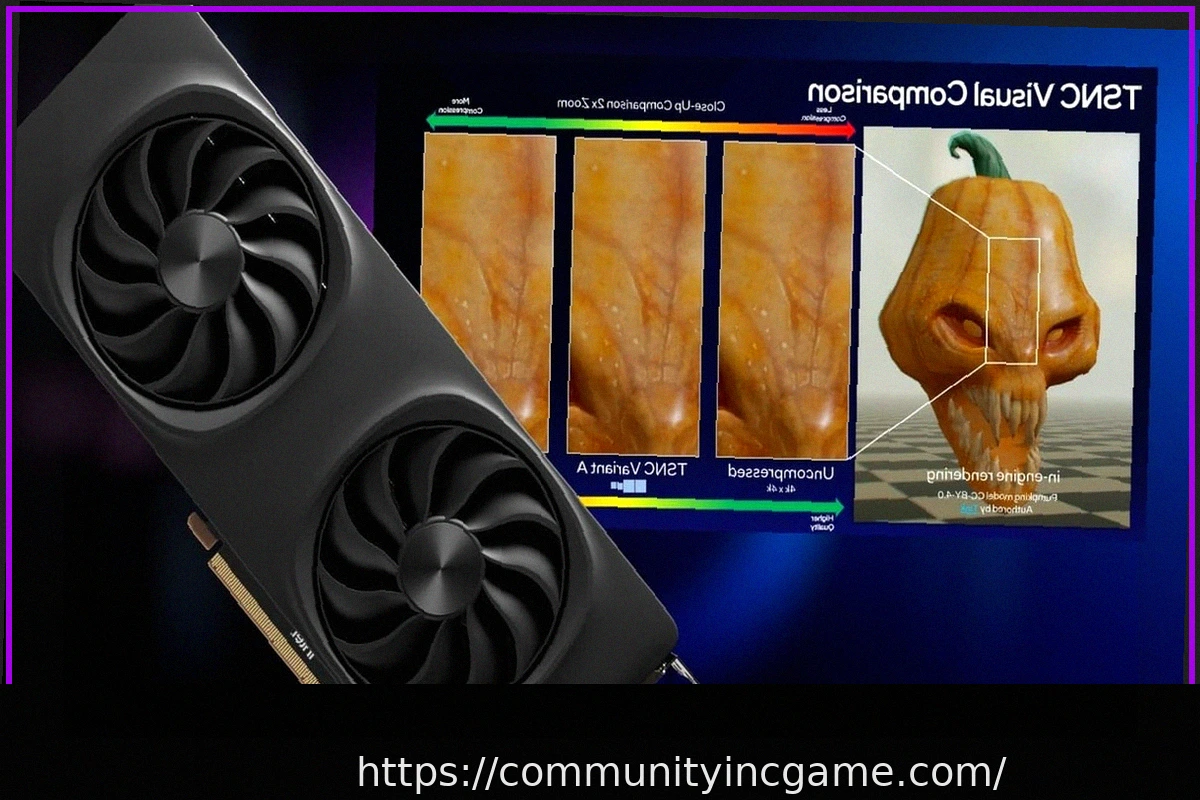
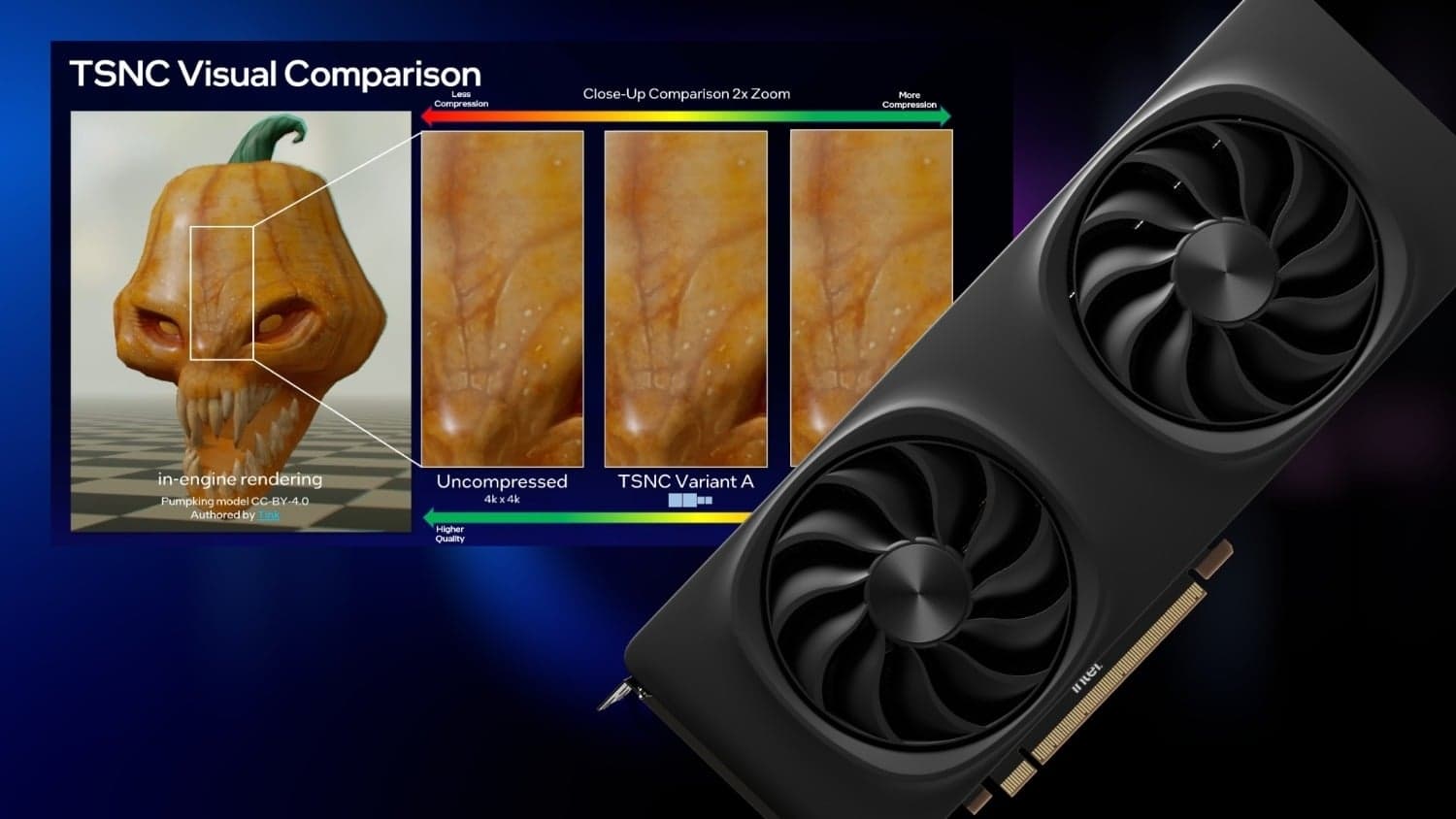
Intel has showcased an updated version of its Texture Set Neural Compression (TSNC) technology, an AI-driven solution for efficient texture compression. This innovative approach significantly reduces the volume of textures by up to 18 times, all while maintaining minimal loss in visual quality. This advancement is set to conserve valuable VRAM, system memory, and disk storage space.
The TSNC technology offers broad compatibility, supporting Intel GPUs equipped with XMX units, as well as upcoming integrated Panther Lake chips featuring Arc B-Series graphics. For wider accessibility, it also includes a fallback mode that allows it to operate on other GPUs and even CPUs.
TSNC functions by compressing standard BC1 textures, a process that can occur either during game installation or dynamically during gameplay. A neural network stores the necessary data to accurately reconstruct the original textures on demand. This system is active during various stages, including installation, game loading, texture streaming, and per-pixel sampling. Intel emphasizes the dual benefits of this technology: not only does it help reduce VRAM consumption, but it also plays a crucial role in decreasing the overall file size of games and their subsequent patches.
The availability of TSNC as a Software Development Kit (SDK) is anticipated later this year. The technology will offer two distinct operational modes: Variant A and Variant B. Variant B represents a more aggressive compression approach, capable of achieving substantial size reductions with a claimed visual quality loss of merely 7%.