

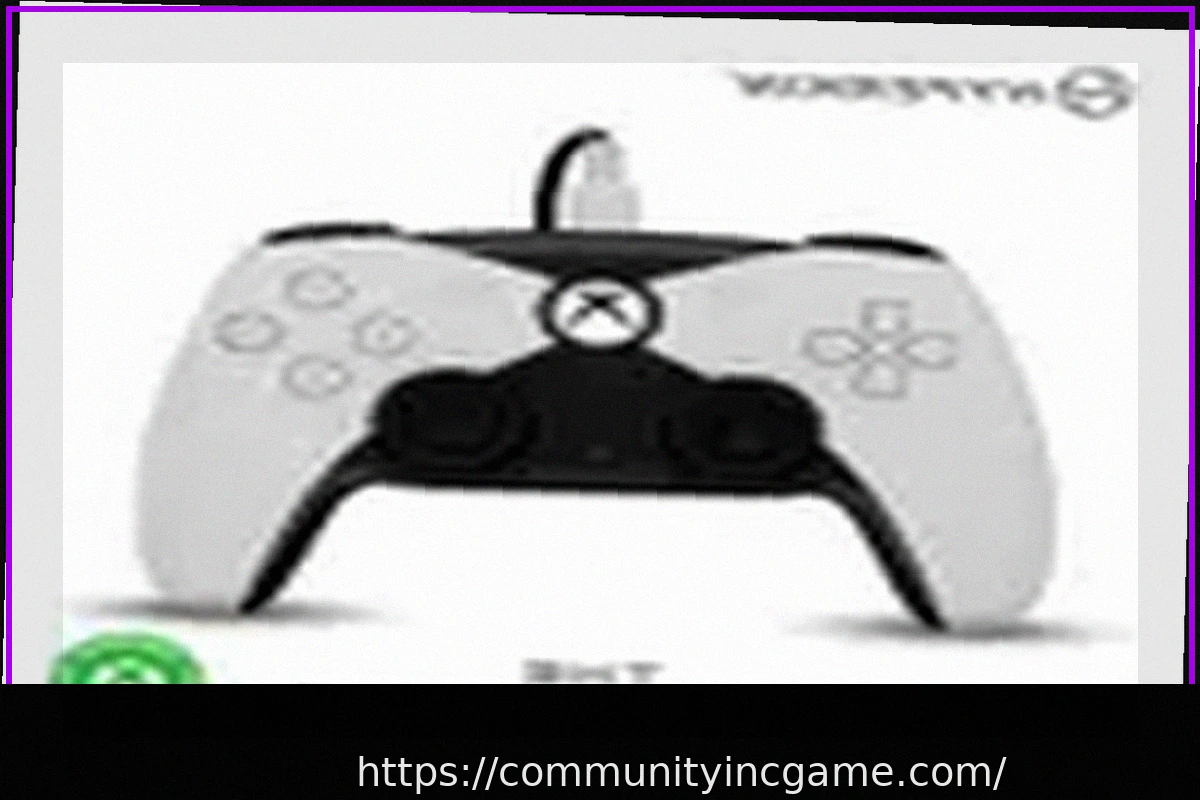
Game controllers generally feature one of two primary stick layouts: the offset design common to Xbox controllers, or the symmetrical arrangement seen on PlayStation devices like the DualSense. This choice is largely a matter of personal preference, yet it often dictates a user’s console choice or requires significant investment in custom hardware to bridge the gap.
Hyperkin’s The Competitor controller seeks to address this by providing a symmetrical stick layout for Xbox and PC users at a considerably lower price point than a standard PS5 controller. This offering aims to provide greater flexibility for gamers.
The Competitor is available in two color schemes: a solid black and a black-and-white variant designed to mimic the aesthetics of the PS5 DualSense. The latter, which was reviewed, presents a stylish, almost superhero-like appearance around the logo.
Priced at approximately $57 USD, the controller necessarily omits some features, yet Hyperkin has still included a surprising array of functionalities. However, its Australian pricing, which ranges from $85 to $120 AUD, can make it feel less competitive, especially when alternatives like the PowerA wireless Dragon controller offer more features (such as programmable back buttons and RGB lighting) within a similar price bracket.
Competitor Specifications:
- Triggers: Hall Effect
- Face Buttons: Xbox Layout
- Back Buttons: Two, programmable and lockable directly on the controller (no software required)
- Sticks: Symmetrical Hall Effect
- Connections: USB Type-C (A to C cable included), 3.5mm headphone jack
- Price: $57 USD | $85 AUD | £30
The controller operates exclusively via a wired connection, lacking Bluetooth or wireless dongle support. It includes a notably long USB Type-C to Type-A cable, which provides ample reach akin to a wireless setup. The cable also features matching black and white styling at its connection points.
Its wired nature contributes to its light weight, officially stated at 234 grams (approx. 250 grams measured). The absence of batteries is discernible when held, though this lightness doesn’t significantly impact gameplay compared to a standard wireless Xbox controller.
It’s crucial to understand that The Competitor is not a substitute for a DualSense controller, given its significantly lower price point. It features standard, non-customizable triggers reminiscent of older PlayStation controllers, offering a decent but basic feel. The haptics are similarly unremarkable, with rumble feedback that could benefit from increased intensity for better in-game awareness.
A notable feature that elevates The Competitor beyond its price segment is its programmable back buttons. Being a wired, plug-and-play device, the two back buttons, conveniently located on the inner grips, can be programmed and disabled directly on the controller without requiring any additional software. While the mapping options are somewhat limited, assigning them to common face buttons like X and B proved effective. Their comfortable placement also minimized accidental presses, a common issue with back buttons on other controllers.
The inclusion of Hall Effect sticks is a significant advantage for a controller under $60 USD. These sticks offer smooth movement and robust centering. Initial use revealed slightly rough textured rims, which subsequently softened. They perform well across various genres, from fast-paced shooters like Doom Eternal to slower titles such as Baldur’s Gate 3, though the D-pad often proves superior for menu navigation and enemy selection in the latter.
Consider Buying If:
- You seek a budget-friendly symmetrical stick controller with added benefits: It’s an excellent option for PC and Xbox users who prefer a PlayStation-style layout without the high cost.
- You frequently encounter accidental back button presses: The controller’s well-designed back buttons are comfortable and resistant to unintentional activation, programmable directly on the device.
Avoid Buying If:
- You are located in Australia: The higher price point in Australia diminishes its value compared to other available options.
- You expect a full DualSense experience on PC: While offering a symmetrical layout, it lacks the advanced haptics and adaptive triggers of Sony’s high-tech controller.
While competent, the D-pad is not a standout feature. Its compact size and raised edges create a somewhat uncomfortable sensation, hindering smooth thumb rolls for multi-directional inputs. Despite its aesthetic appeal with a transparent coating similar to the face buttons, its tactile feel is not particularly satisfying.
The face buttons, labeled with Xbox iconography, exhibit a slightly ‘mushy’ feel, lacking crisp actuation. Similar issues extend to the bumpers, which suffer from a somewhat soft or delayed response. During gameplay, particularly in fast-paced titles like Hades 2, this can lead to missed inputs; for instance, abilities set to bumpers or the B button sometimes fail to register without deliberate, heavy presses. Consequently, overall gameplay responsiveness and speed felt diminished compared to a standard Xbox Wireless controller.
The Hyperkin Competitor successfully offers a symmetrical stick layout compatible with PC and Xbox, addressing a niche market at a generally reasonable price for specific regions. For US consumers, it presents a feature-rich, user-friendly device. However, Australian buyers might find better-featured alternatives in the same price range, potentially offering a more optimized gaming experience.