Intel Unveils AI Texture Compression to Save VRAM and Disk Space
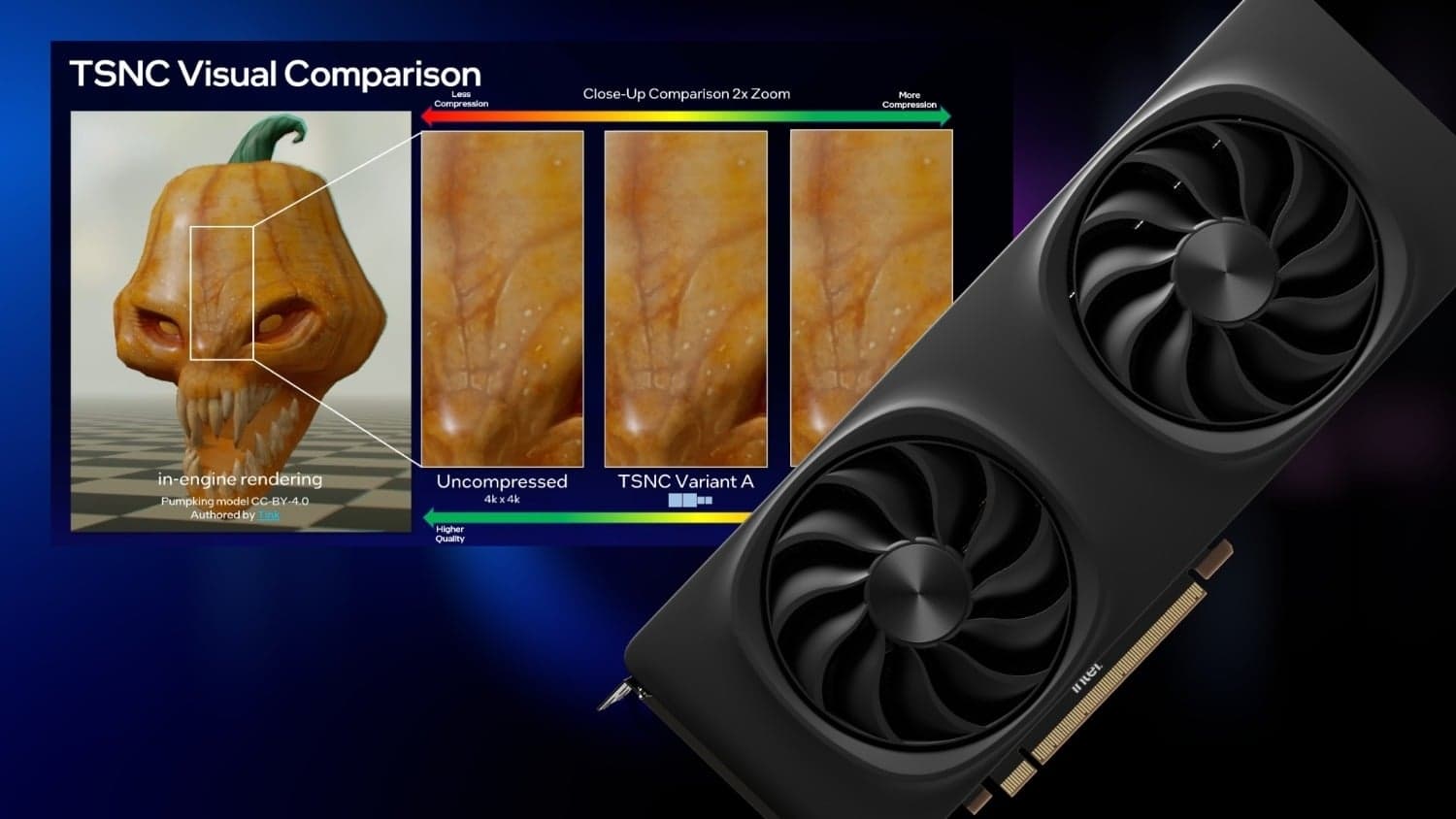
Intel has showcased an updated version of its Texture Set Neural Compression (TSNC) technology, an AI-driven solution for efficient texture compression. This innovative approach significantly reduces the volume of textures by up to 18 times, all while maintaining minimal loss in visual quality. This advancement is set to conserve valuable VRAM, system memory, and disk storage space.
The TSNC technology offers broad compatibility, supporting Intel GPUs equipped with XMX units, as well as upcoming integrated Panther Lake chips featuring Arc B-Series graphics. For wider accessibility, it also includes a fallback mode that allows it to operate on other GPUs and even CPUs.
TSNC functions by compressing standard BC1 textures, a process that can occur either during game installation or dynamically during gameplay. A neural network stores the necessary data to accurately reconstruct the original textures on demand. This system is active during various stages, including installation, game loading, texture streaming, and per-pixel sampling. Intel emphasizes the dual benefits of this technology: not only does it help reduce VRAM consumption, but it also plays a crucial role in decreasing the overall file size of games and their subsequent patches.
The availability of TSNC as a Software Development Kit (SDK) is anticipated later this year. The technology will offer two distinct operational modes: Variant A and Variant B. Variant B represents a more aggressive compression approach, capable of achieving substantial size reductions with a claimed visual quality loss of merely 7%.
Fresh materials — Gaming News
Fortnite's V-Bucks Price Increase Due to Rising Operational Costs
Epic Games has announced an upcoming price adjustment for Fortnite's V-Bucks, the in-game currency used for purchasing cosmetic items and battle passes. This change is attributed to a substantial rise in the operational expenses associated with running the popular battle royale game. The company
Nvidia GTC Keynote: Jen-Hsun Huang Unveils the Future of Real-Time Rendering
During the recent Nvidia GTC keynote, CEO Jen-Hsun Huang presented a compelling vision for what he described as "the future of real-time rendering." The presentation hinted at advancements that could potentially be "mind-blowing." While the specifics of the most revolutionary developments rema
Extraction Shooter Spends 7 Minutes and 38 Seconds to Eliminate a Single Player
In a recent display of extreme patience and strategic gameplay, a player in an extraction shooter reportedly spent a staggering 7 minutes and 38 seconds to eliminate just one specific opponent. The extended duration of this engagement highlights a particular aspect of the extraction shooter genre
Over 48% of Unreleased Games Have Discord Servers
It's remarkable that more than 48% of games that haven't even been released yet have established a presence on Discord. This trend suggests a significant shift in how game developers are engaging with their communities, prioritizing real-time interaction and direct feedback over traditional online
You're Laughing as Thomas the Tank Engine Faces Brutal Demise in Unreal Engine Physics
The beloved children's character, Thomas the Tank Engine, is unexpectedly experiencing a new kind of adventure, albeit a rather violent one, thanks to the advanced physics engine of Unreal Engine. What was once a gentle world of friendship and learning has transformed into a chaotic playground whe
If there's one thing I've learned playing Crimson Desert for 75 hours, it's that you should absolutely treat this game as a slow burn
After investing 75 hours into Crimson Desert, a clear lesson has emerged: this game is best approached as a gradual unfolding experience. Embrace its deliberate pace, and you'll unlock its true potential. The initial hours might feel like a gentle introduction, but don't be mistaken. Crimso