

Dorohedoro defies conventional narratives, lacking clear-cut heroes or villains. It’s a world where people are dismembered, transmuted into mushrooms, and engage in baseball with a three-meter cockroach, while a zombie apocalypse has long been celebrated as a festival. Violence is a mundane occurrence here, yet beneath the chaos, brutality, and grotesque imagery lies one of the most vibrant anime of recent years. With the second season having premiered on April 1st, it’s the perfect opportunity to revisit the Hole and delve into what makes Dorohedoro truly unique.
Grime Mixed with Grime
Dorohedoro is an adaptation of Q Hayashida’s manga of the same name, which she meticulously crafted from 2000 to 2018. The anime adaptation was handled by Studio MAPPA, a company well-versed in creating harsh, dark, and visually aggressive content. Their portfolio includes acclaimed titles like “Attack on Titan,” “Chainsaw Man,” and “Jujutsu Kaisen,” projects that consistently dominate the anime discourse with each new season.
Despite MAPPA’s pedigree, Dorohedoro remains a niche gem. It’s too grimy, too peculiar, and too chaotic to achieve mainstream blockbuster status. Initially, it might seem designed solely to shock viewers with its blend of ugliness, violence, and absurdity. However, this impression is deceiving. Dorohedoro only *pretends* to be pure chaos. Beneath its aggressive exterior lies a profound story about individuals striving to retain their essence in a world where brutality has long been normalized.
This deliberate sense of rawness is largely attributable to Q Hayashida herself. Little is known about the manga artist, who consciously stays out of the spotlight and works under a pseudonym. Before Dorohedoro, she had already released a manga adaptation of Atlus’s slasher game Maken X Another. Hayashida also contributed to boss designs for Shadows of the Damned. Her penchant for visceral textures, grotesquery, and black humor often makes Dorohedoro feel like a creation that could have emerged from the depths of Grasshopper Manufacture.
From Hayashida’s rare interviews, it’s known that she’s drawn not to “beautiful” forms but to roughness, corporeality, and imperfection—qualities almost physically palpable even in her artwork. The title itself is indicative: “Dorohedoro” is often translated as “dirt mixed with dirt” or “grime mixed with grime.” This isn’t merely a clever metaphor; it’s an accurate depiction of a world where everything blurs into indistinction: ugliness and comfort, cruelty and mundane life, chaos and precise structure.
Hayashida crafted Dorohedoro without assistants, meticulously structuring chapters, developing the plot, arranging scenes, and refining dialogues even before the final artwork. For her, it was crucial that the story resonated through visceral experience rather than explicit exposition.
Thus, Dorohedoro doesn’t spell out its meanings overtly; instead, it compels viewers and readers to piece together its world from fragments, details, and confrontations. Almost nothing here is accidental. Even minor elements that initially seem merely strange or amusing can later reveal a character’s depth, shift a scene’s focus, or illustrate the true nature of this bizarre reality.
A World Where Violence Became the Backdrop
Dorohedoro centers on a two-meter brute named Kaiman, who one day awakens in a grimy alley, encased in a body bag. Yet, this is far from his most pressing concern.
His much bigger problem is that he now possesses a reptilian head instead of a human one. Furthermore, Kaiman has lost his memory and cannot recall his past identity. His sole objective becomes clear: find the sorcerer who cursed him, kill them, and reclaim his original form and life.
The curse not only disfigured Kaiman but also rendered him unique. He is completely immune to magic and can shove sorcerers’ heads into his mouth. Afterward, a mysterious figure with crosses around his eyes emerges from Kaiman’s throat, delivering a verdict: whether this is the sorcerer who transformed Kaiman, or if the search must continue.
It’s an unconventional method, but it’s Kaiman’s only recourse. Time and again, he hunts down sorcerers, aided by Nikaido, the spirited owner of the “Hungry Bug” diner, renowned throughout the district for her pan-fried gyoza—a dish Kaiman simply cannot go a day without.
However, it would be a mistake to assume this is merely another run-of-the-mill revenge story. The narrative is far more intricate, as the world of Dorohedoro itself is fractured into two distinct realities.
The first is the Hole. Its very name unambiguously suggests that nothing good can be expected from this place. And indeed, it’s an industrial ghetto characterized by grimy streets, dilapidated buildings, and inhabitants struggling desperately to survive. There’s no police, no authority, not even a semblance of order here.
The second reality is the Sorcerers’ World. This realm is more elaborate, almost theatrical, and noticeably more prosperous. While it has its own share of problems, life is generally better there—if only because no one from another dimension invades for experiments on its inhabitants. Sorcerers, however, freely infiltrate the Hole through portals, maiming and killing people, treating them as mere disposable experimental subjects.
Moreover, magic in this world bears no resemblance to fantastical enchantment. Here, it manifests as a thick, black smoke—an ironic inversion of Arthur C. Clarke’s famous adage, where magic resembles a toxic technology, polluting the environment and disfiguring human bodies.
At one point, humans attempted to resist, but the odds were overwhelmingly against them. Gradually, most simply resigned themselves. Sorcerers exploit this complacency, knowing there’s little to stop them in the Hole. Consequently, violence here isn’t an anomaly; it’s an inherent part of the environment itself.
This setup might seem to encourage a simplistic division: the oppressed versus the oppressors, victims versus perpetrators. Yet, it quickly becomes clear that Dorohedoro has no intention of categorizing everyone into neat, convenient boxes.
No Heroes, No Villains
Initially, we witness Kaiman systematically terrorizing sorcerers in the Hole, relentless in his quest to find the one who stole his memory and transformed him into a lizard. However, the anime soon shifts perspective, showing events through the eyes of the sorcerers themselves. To them, Kaiman is not a sympathetic avenger but a crocodile-headed monster who invades their lives, kills, and leaves behind mutilated bodies.
Consequently, Dorohedoro doesn’t feature a single protagonist in the traditional sense. We observe this grotesque world from various sides of the conflict, gradually delving into the motivations, fears, and internal logic of almost every character. It quickly becomes evident that in a world where old norms have long crumbled and new ones have yet to emerge, individuals can rarely afford to simply “be themselves.” Their actions are dictated less by moral principles and more by circumstances and the balance of power.
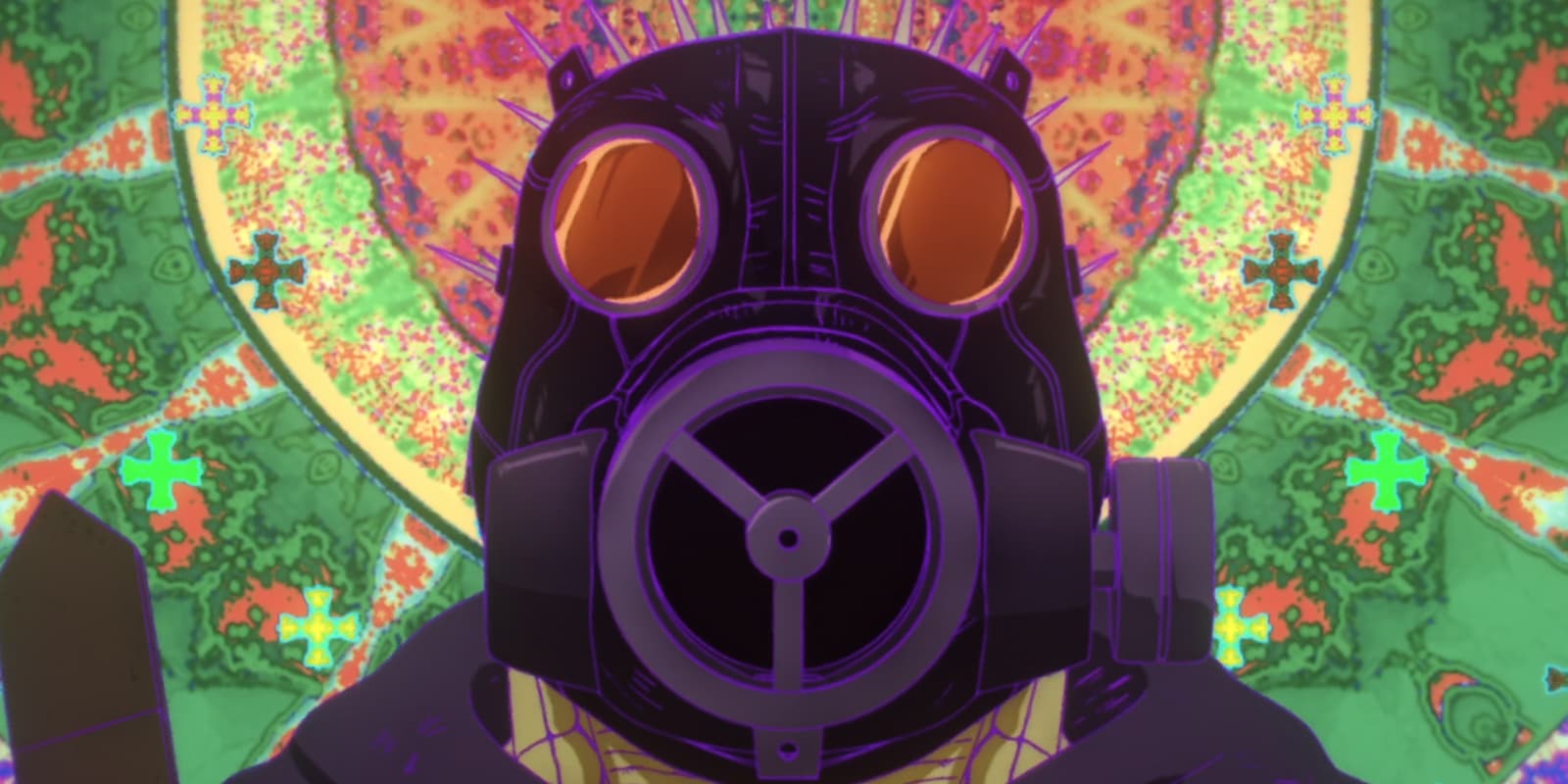
To preserve their identities, many characters retreat into a function, a role, a mask. Almost everyone wears masks here, especially when committing acts of violence. These masks conceal faces, erase expressions, and seemingly free individuals from the obligation to feel. The personal dissolves into the functional. In such a state, violence is no longer perpetrated by a specific person but by the role they embody—the banality of evil in full display.
This is why moments when masks are removed, literally or metaphorically, are so crucial. It reveals that in Dorohedoro’s world, there are almost no unambiguously good or entirely evil characters. Beneath the most horrifying exteriors, one nearly always discovers a person with their own fears, habits, attachments, and motivations.
Initially, you begin to understand them, and then you find yourself sympathizing with and worrying about them. This is because these individuals not only perpetuate a system of violence but are also profoundly scarred by it themselves.
This is best exemplified by characters who, by genre conventions, should have remained mere impactful secondary villains. Take Shin and Noi, En’s cleaners—En being a crime boss and one of the most powerful sorcerers in this world. Officially, they are murderers for whom violence has long been a routine job. Yet, Shin’s story is not that of a villain in the conventional sense. It’s the tale of a man who was first broken, then taught to survive in the only way he knew how.
Despite this, Shin doesn’t fully dissolve into his role as a killer. He adheres to his own principles, refusing to use magic against those who don’t possess it themselves, even when facing death. And beneath his heart-shaped mask truly beats a living heart that remembers not only the evil inflicted upon him but also kindness. He is capable of reciprocating that kindness, even towards a nominal enemy. These principles help him retain his identity in a world of total chaos.
Noi’s situation is even more intriguing. She wields healing magic, a power that in any other story would automatically brand her as a force for good. However, Dorohedoro rejects such simplistic categorizations. Noi can literally piece a person back together, pull them back from the brink of death, and undo the consequences of another’s cruelty. Yet, herein lies the paradox: she can save an individual, but she cannot rectify the environmental logic that immediately turns this salvation into a continuation of brutality.
En can be viewed through the same lens; he would easily be labeled the primary antagonist. He builds a criminal empire, eliminates dissenters, and unflinchingly transforms those who displease him into mushrooms. Yet, he also gathers a semblance of a family around him and genuinely cares for his people. Furthermore, his empire largely arose as a response to the exploitation of sorcerers. This context makes his cruelty appear not as abstract evil but as another method of imposing order in a world where the very concept of order has all but vanished.
It’s easy to slip into clichés here, like “we’re not bad, life just made us this way,” but Dorohedoro pushes this idea to its extreme. Typically, such stories feature one tragically broken villain given a carefully constructed tragic past. Here, it’s different. This is how the entire world lives. Everyone is deformed by their environment, everyone has learned to survive through violence, and everyone is, in one way or another, stained with blood.
Thus, brutality in Dorohedoro functions not as an exceptional event or a dramatic climax. It doesn’t halt the narrative but is woven into the very fabric of everyday life. Characters can engage in a bloody massacre, then a minute later calmly eat, argue, joke, or discuss evening plans. For them, there’s no contradiction in this, because the world has long operated by these rules.
Humanity Within Chaos
The same gradual shift occurs for the viewer. Initially, Dorohedoro shocks with its mundane cruelty – not just the sheer volume of blood, but the effortless, natural way the most horrific acts are committed. But the longer you watch, the more your perspective shifts.
The violence doesn’t disappear or become any less horrifying. However, it ceases to be the *only* thing you notice. And then, entirely different elements begin to emerge: a friendly dinner, a silly joke, repetitive rituals and promises that suddenly hold more weight than any grand pronouncements.
The essence here isn’t in abstract morality or a set of correct slogans. In Dorohedoro’s world, the formula “I don’t kill anyone, therefore I am good” simply doesn’t apply. Something vital is preserved in other aspects: in how people coexist, in care, in attachment, in the very act of returning to one another, and in rituals that maintain a sense of normalcy.
It’s no coincidence that during anxious times, people often rewatch familiar films and series. The recognizable provides comfort; repetition creates an illusion of control. In Dorohedoro, something similar happens with its characters.
Shin and Noi repeatedly return to the same diner. They eat competitively, joke, and tease each other. They are fascinating to watch, and you begin to care for them, even feeling a slight awkwardness as their relationship balances between familial closeness and suppressed romance. All of this demonstrates that they haven’t entirely dissolved into violence. They lead ordinary lives beyond their killings. And as long as these small habits are reproduced, a fragile illusion remains that the world hasn’t completely fallen apart.
The same dynamic plays out between Kaiman and Nikaido. A genuine bond forms between them, rooted in the simplest domestic routines. Nikaido provides him not just food but also an anchor in a world where he has no past, no normal body, and not even his own name. He returns to her repeatedly, not solely because he loves gyoza, but because, beside her, he finds some semblance of a normal life.
And it’s within this mundane, almost absurd domesticity that something truly alive emerges. The world might be falling apart, and guts might be spilling out, but Kaiman, having just had his head severed, first thinks about bringing Nikaido the meat grinder they fought over on the Day of the Dead. This is one of the first season’s most powerful moments. Because friends keep their word. And because now, gyoza can be prepared faster.
At times, Dorohedoro even resembles a culinary anime. This isn’t just a quirky contrast like “here’s some gore, and here are some appetizing dumplings.” Food here serves a very specific function: it also restores a sense of normalcy to the world. Everyone eats; it’s a simple, primal, almost animalistic act.
That’s why Nikaido’s gyoza mean far more than just Kaiman’s favorite dish. They represent something beautiful and proper in a world where almost everything else is distorted and broken. They are a marker of attachment and life. A person eats, therefore they live. A person cooks for another, therefore they care. A person returns to the same place for the same dish, therefore they are trying to hold onto something stable in the world. And the more broken the world itself is, the more these simple things mean.
The same applies to its humor. Despite its pervasive grimness, Dorohedoro constantly finds ways to be funny, not merely as comic relief *over* the horror, but often *within* it. The most brutal scenes can easily conclude with some absurd, mundane detail. Shin’s bloody backstory, filled with murder and dismemberment, abruptly cuts to him simply sneezing loudly. It’s a trivial moment, yet it works brilliantly, not fully releasing the tension but making it feel even more textured and real.
The world doesn’t freeze into one continuous tragedy. It continues to breathe, chomp, joke, argue, eat, curse, play baseball with the dead and a three-meter cockroach. This is why it feels not like a cardboard nightmare, but a physical environment in which someone genuinely lives.
This contrast makes all these elements profoundly important. In a hypothetically normal world, friendship, food, care, and silly habits are often taken for granted as background. But here, against the relentless grime, cruelty, and absurdity, they come to the forefront, preventing characters from completely losing their humanity.
Verdict
Dorohedoro only *feigns* chaos. On the surface, it’s a torrent of grime, blood, and absurdity, where many events appear almost random. Yet, this anime is far more precisely constructed than it initially seems. Food, masks, mundane scenes, the contrast between the grotesque and the cozy—everything here serves a single purpose: to depict a world where humanity doesn’t *conquer* violence but stubbornly refuses to be erased by it.
Therefore, Dorohedoro is not merely a story about Kaiman and his quest. It’s a fully realized world where the entire ensemble of characters and the environment they strive to survive in are equally important. The fascination stems not only from its mysteries and resolutions but also from its vivid characters, imagery, and the very feeling of life that persists through bloodshed and daily routine.
Ultimately, this world begins to speak not just about itself, but about us. True, our reality isn’t the Hole, and three-meter cockroaches and demons aren’t yet roaming our streets. But we too live in a world where cruelty too easily becomes background noise, dry statistics, and headlines that flash before our eyes and then vanish.
Yet, this doesn’t imply that humanity is doomed. It resides in the same place it does for Dorohedoro’s characters: in the ability to maintain connections, in small rituals, in the capacity to find joy, to care, to laugh, and to establish internal rules for oneself even when chaos reigns supreme.
This is why Dorohedoro simultaneously feels like one of the most repulsive and most comforting anime of recent years. It might initially deter viewers with its design, crudeness, and abundance of gore, but if you linger a bit longer, you quickly realize that all this wildness isn’t just for shock value. Through the grime, brutality, and absurdity emerges an anime about people, rare in its precision and tone. That’s why one wants to return to the Hole, and the release of the second season is an excellent reason to finally dive in, for this world has become even crazier, bloodier, and more alive.